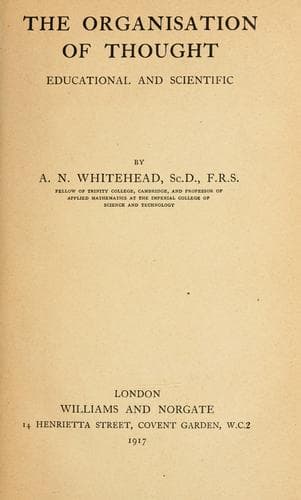
The organisation of thought, educational and scientificWhitehead, Alfred North
Philosophy
The organisation of thought, educational and scientific
Whitehead, Alfred North
Education
I doubt, however, whether it is desirable to plunge the student into
the full rigour of euclidean geometry without some mitigation. It is
for this reason that the modern habit, at least in England, of laying
great stress in the initial stages on training the pupil in simple
constructions from numerical data is to be praised. It means that after
a slight amount of reasoning on the euclidean basis of accuracy, the
mind of the learner is relieved by doing the things in various special
cases, and noting by rough measurements that the desired results are
actually attained. It is important, however, that the measurements
be not mistaken for the proofs. Their object is to make the beginner
apprehend what the abstract ideas really mean.
Again in algebra, the notation and the practical use of the symbols
should be acquired in the simplest cases, and the more theoretical
treatment of the symbolism reserved to a suitable later stage. My
rule would be initially to learn the meaning of the ideas by a crude
practice in simple ways, and to refine the logical procedure in
preparation for an advance to greater generality. In fact the thesis of
my paper can be put in another way thus, the object of a mathematical
education is, to acquire the powers of analysis, of generalisation,
and of reasoning. The two processes of analysis and generalisation were
in my previous statement put together as the power of grasping abstract
ideas.
But in order to analyse and to generalise, we must commence with the
crude material of ideas which are to be analysed and generalised.
Accordingly it is a positive error in education to start with the
ultimate products of this process, namely the ideas in their refined
analysed and generalised forms. We are thereby skipping an important
part of the training, which is to take the ideas as they actually exist
in the child's mind, and to exercise the child in the difficult art of
civilising them and clothing them.
The schoolmaster is in fact a missionary, the savages are the ideas in
the child's mind; and the missionary shirks his main task if he refuse
to risk his body among the cannibals.
At this point I should like to turn your attention to those pupils
forming the mathematical section. There is an idea, widely prevalent,
that it is possible to teach mathematics of a relatively advanced
type--such as differential calculus, for instance--in a way useful to
physicists and engineers without any attention to its logic or its
theory.
Public-domain text, read in full here on John Shaqi.
Reviews
Reviews
No reviews yet
Be the first to share your thoughts on this work.
Elsewhere in the archive
Join the Discussion
Join the discussion
Sign in to leave a comment or review.
Sign InorCreate an account