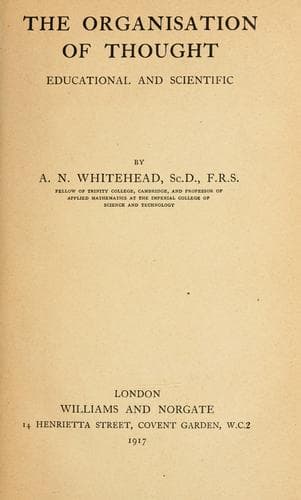
The organisation of thought, educational and scientificWhitehead, Alfred North
Philosophy
The organisation of thought, educational and scientific
Whitehead, Alfred North
Education
It is no accident that an age of science has developed into an age
of organisation. Organised thought is the basis of organised action.
Organisation is the adjustment of diverse elements so that their
mutual relations may exhibit some predetermined quality. An epic poem
is a triumph of organisation, that is to say, it is a triumph in the
unlikely event of its being a good epic poem. It is the successful
organisation of multitudinous sounds of words, associations of words,
pictorial memories of diverse events and feelings ordinarily occurring
in life, combined with a special narrative of great events: the whole
so disposed as to excite emotions which, as defined by Milton, are
simple, sensuous, and passionate. The number of successful epic poems
is commensurate, or rather, is inversely commensurate, with the obvious
difficulty of the task of organisation.
Science is the organisation of thought. But the example of the epic
poem warns us that science is not any organisation of thought. It is
an organisation of a certain definite type which we will endeavour to
determine.
Science is a river with two sources, the practical source and the
theoretical source. The practical source is the desire to direct our
actions to achieve predetermined ends. For example, the British nation,
fighting for justice, turns to science, which teaches it the importance
of compounds of nitrogen. The theoretical source is the desire to
understand. Now I am going to emphasise the importance of theory in
science. But to avoid misconception I most emphatically state that I
do not consider one source as in any sense nobler than the other, or
intrinsically more interesting. I cannot see why it is nobler to strive
to understand than to busy oneself with the right ordering of one's
actions. Both have their bad sides; there are evil ends directing
actions, and there are ignoble curiosities of the understanding.
The importance, even in practice, of the theoretical side of science
arises from the fact that action must be immediate, and takes place
under circumstances which are excessively complicated. If we wait for
the necessities of action before we commence to arrange our ideas, in
peace we shall have lost our trade, and in war we shall have lost the
battle. Success in practice depends on theorists who, led by other
motives of exploration, have been there before, and by some good chance
have hit upon the relevant ideas. By a theorist I do not mean a man who
is up in the clouds, but a man whose motive for thought is the desire
to formulate correctly the rules according to which events occur. A
successful theorist should be excessively interested in immediate
events, otherwise he is not at all likely to formulate correctly
anything about them. Of course, both sources of science exist in all
men.
Public-domain text, read in full here on John Shaqi.
Reviews
Reviews
No reviews yet
Be the first to share your thoughts on this work.
Elsewhere in the archive
Join the Discussion
Join the discussion
Sign in to leave a comment or review.
Sign InorCreate an account