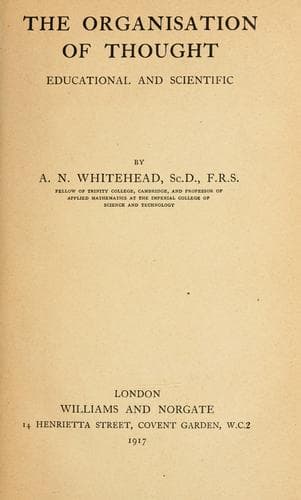
The organisation of thought, educational and scientificWhitehead, Alfred North
Philosophy
The organisation of thought, educational and scientific
Whitehead, Alfred North
Education
But, for the purpose of science, what is the actual world? Has science
to wait for the termination of the metaphysical debate till it can
determine its own subject-matter? I suggest that science has a much
more homely starting-ground. Its task is the discovery of the relations
which exist within that flux of perceptions, sensations, and emotions
which forms our experience of life. The panorama yielded by sight,
sound, taste, smell, touch, and by more inchoate sensible feelings,
is the sole field of activity. It is in this way that science is the
thought organisation of experience. The most obvious aspect of this
field of actual experience is its disorderly character. It is for
each person a _continuum_, fragmentary, and with elements not
clearly differentiated. The comparison of the sensible experiences of
diverse people brings its own difficulties. I insist on the radically
untidy, ill-adjusted character of the fields of actual experience from
which science starts. To grasp this fundamental truth is the first
step in wisdom, when constructing a philosophy of science. This fact
is concealed by the influence of language, moulded by science, which
foists on us exact concepts as though they represented the immediate
deliverances of experience. The result is, that we imagine that we have
immediate experience of a world of perfectly defined objects implicated
in perfectly defined events which, as known to us by the direct
deliverance of our senses, happen at exact instants of time, in a space
formed by exact points, without parts and without magnitude: the neat,
trim, tidy, exact world which is the goal of scientific thought.
My contention is, that this world is a world of ideas, and that its
internal relations are relations between abstract concepts, and that
the elucidation of the precise connection between this world and the
feelings of actual experience is the fundamental question of scientific
philosophy. The question which I am inviting you to consider is this:
How does exact thought apply to the fragmentary, vague _continua_
of experience? I am not saying that it does not apply: quite the
contrary. But I want to know how it applies. The solution I am
asking for is not a phrase, however brilliant, but a solid branch of
science, constructed with slow patience, showing in detail how the
correspondence is effected.
Public-domain text, read in full here on John Shaqi.
Reviews
Reviews
No reviews yet
Be the first to share your thoughts on this work.
Elsewhere in the archive
Join the Discussion
Join the discussion
Sign in to leave a comment or review.
Sign InorCreate an account