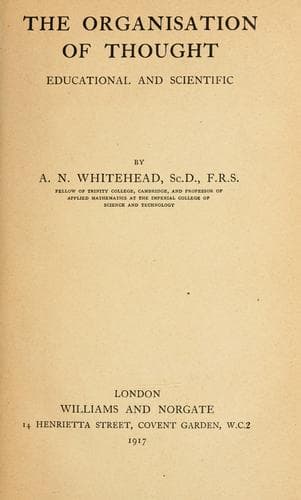
The organisation of thought, educational and scientificWhitehead, Alfred North
Philosophy
The organisation of thought, educational and scientific
Whitehead, Alfred North
Education
The first great steps in the organisation of thought were due
exclusively to the practical source of scientific activity, without
any admixture of theoretical impulse. Their slow accomplishment was
the cause and also the effect of the gradual evolution of moderately
rational beings. I mean the formation of the concepts of definite
material objects, of the determinate lapse of time, of simultaneity,
of recurrence, of definite relative position, and of analogous
fundamental ideas, according to which the flux of our experience is
mentally arranged for handy reference: in fact, the whole apparatus of
commonsense thought. Consider in your mind some definite chair. The
concept of that chair is simply the concept of all the interrelated
experiences connected with that chair--namely, of the experience of the
folk who made it, of the folk who sold it, of the folk who have seen
it or used it, of the man who is now experiencing a comfortable sense
of support, combined with our expectations of an analogous future,
terminated finally by a different set of experiences when the chair
collapses and becomes firewood. The formation of that type of concept
was a tremendous job, and zoologists and geologists tell us that it
took many tens of millions of years. I can well believe it.
I now emphasise two points. In the first place, science is rooted in
what I have just called the whole apparatus of commonsense thought.
That is the _datum_ from which it starts, and to which it
must recur. We may speculate, if it amuses us, of other beings in
other planets who have arranged analogous experiences according to
an entirely different conceptual code--namely, who have directed
their chief attention to different relations between their various
experiences. But the task is too complex, too gigantic, to be revised
in its main outlines. You may polish up commonsense, you may contradict
it in detail, you may surprise it. But ultimately your whole task is to
satisfy it.
In the second place, neither commonsense nor science can proceed with
their task of thought organisation without departing in some respect
from the strict consideration of what is actual in experience. Think
again of the chair. Among the experiences upon which its concept is
based, I included our expectations of its future history. I should
have gone further and included our imagination of all the possible
experiences which in ordinary language we should call perceptions of
the chair which might have occurred. This is a difficult question, and
I do not see my way through it. But, at present, in the construction of
a theory of space and of time there seem insuperable difficulties if we
refuse to admit ideal experiences.
Public-domain text, read in full here on John Shaqi.
Reviews
Reviews
No reviews yet
Be the first to share your thoughts on this work.
Elsewhere in the archive
Join the Discussion
Join the discussion
Sign in to leave a comment or review.
Sign InorCreate an account