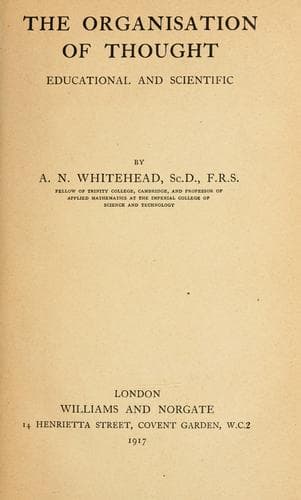
The organisation of thought, educational and scientificWhitehead, Alfred North
Philosophy
The organisation of thought, educational and scientific
Whitehead, Alfred North
Education
We can discern four departments of logical theory. By an analogy
which is not so very remote I will call these departments or sections
the arithmetic section, the algebraic section, the section of
general-function theory, the analytical section. I do not mean that
arithmetic arises in the first section, algebra in the second section,
and so on; but the names are suggestive of certain qualities of
thought in each section which are reminiscent of analogous qualities
in arithmetic, in algebra, in the general theory of a mathematical
function, and in the mathematical analysis of the properties of
particular functions.
The first section--namely, the arithmetic stage--deals with the
relations of definite propositions to each other, just as arithmetic
deals with definite numbers. Consider any definite proposition; call
it "_p_." We conceive that there is always another proposition which
is the direct contradictory to "_p_"; call it "not-_p_." When we have
got two propositions, _p_ and _q_, we can form derivative propositions
from them, and from their contradictories. We can say, "At last one of
_p_ or _q_ is true, and perhaps both." Let us call this proposition
"_p_ or _q_." I may mention as an aside that one of the greatest living
philosophers has stated that this use of the word "or"--namely, "_p_ or
_q_" in the sense that either or both may be true--makes him despair of
exact expression. We must brave his wrath, which is unintelligible to
me.
We have thus got hold of four new propositions, namely, "_p_ or _q_,"
and "not-_p_ or _q_," and "_p_ or not-_q_," and "not-_p_ or not-_q_."
Call these the set of disjunctive derivatives. There are, so far,
in all eight propositions, _p_, not-_p_, _q_, not-_q_, and the four
disjunctive derivatives. Any pair of these eight propositions can be
taken, and substituted for _p_ and _q_ in the foregoing treatment.
Thus each pair yields eight propositions, some of which may have been
obtained before. By proceeding in this way we arrive at an unending set
of propositions of growing complexity, ultimately derived from the two
original propositions _p_ or _q_. Of course, only a few are important.
Similarly we can start from three propositions, _p_, _q_, _r_, or
from four propositions, _p_, _q_, _r_, _s_, and so on. Any one of the
propositions of these aggregates may be true or false. It has no other
alternative. Whichever it is, true or false, call it the "truth-value"
of the proposition.
The first section of logical inquiry is to settle what we know of the
truth-values of these propositions, when we know the truth-values of
some of them. The inquiry, so far as it is worth while carrying it,
is not very abstruse, and the best way of expressing its results is a
detail which I will not now consider. This inquiry forms the arithmetic
stage.
Public-domain text, read in full here on John Shaqi.
Reviews
Reviews
No reviews yet
Be the first to share your thoughts on this work.
Elsewhere in the archive
Join the Discussion
Join the discussion
Sign in to leave a comment or review.
Sign InorCreate an account