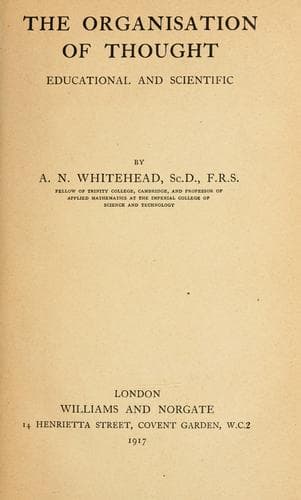
The organisation of thought, educational and scientificWhitehead, Alfred North
Philosophy
The organisation of thought, educational and scientific
Whitehead, Alfred North
Education
My immediate problem is to inquire into the nature of the texture of
science. Science is essentially logical. The nexus between its concepts
is a logical nexus, and the grounds for its detailed assertions
are logical grounds. King James said, "No bishops, no king." With
greater confidence we can say, "No logic, no science." The reason for
the instinctive dislike which most men of science feel towards the
recognition of this truth is, I think, the barren failure of logical
theory during the past three or four centuries. We may trace this
failure back to the worship of authority, which in some respects
increased in the learned world at the time of the Renaissance. Mankind
then changed its authority, and this fact temporally acted as an
emancipation. But the main fact, and we can find complaints[2] of it
at the very commencement of the modern movement, was the establishment
of a reverential attitude towards any statement made by a classical
author. Scholars became commentators on truths too fragile to bear
translation. A science which hesitates to forget its founders is lost.
To this hesitation I ascribe the barrenness of logic. Another reason
for distrust of logical theory and of mathematics is the belief that
deductive reasoning can give you nothing new. Your conclusions are
contained in your premises, which by hypothesis are known to you.
In the first place this last condemnation of logic neglects the
fragmentary, disconnected character of human knowledge. To know one
premise on Monday, and another premise on Tuesday, is useless to you
on Wednesday. Science is a permanent record of premises, deductions,
and conclusions, verified all along the line by its correspondence
with facts. Secondly, it is untrue that when we know the premises we
also know the conclusions. In arithmetic, for example, mankind are not
calculating boys. Any theory which proves that they are conversant with
the consequences of their assumptions must be wrong. We can imagine
beings who possess such insight. But we are not such creatures.
Both these answers are, I think, true and relevant. But they are
not satisfactory. They are too much in the nature of bludgeons,
too external. We want something more explanatory of the very real
difficulty which the question suggests. In fact, the true answer is
embedded in the discussion of our main problem of the relation of logic
to natural science.
It will be necessary to sketch in broad outline some relevant features
of modern logic. In doing so I shall try to avoid the profound general
discussions and the minute technical classifications which occupy the
main part of traditional logic. It is characteristic of a science in
its earlier stages--and logic has become fossilised in such a stage--to
be both ambitiously profound in its aims and trivial in its handling of
details.
Public-domain text, read in full here on John Shaqi.
Reviews
Reviews
No reviews yet
Be the first to share your thoughts on this work.
Elsewhere in the archive
Join the Discussion
Join the discussion
Sign in to leave a comment or review.
Sign InorCreate an account