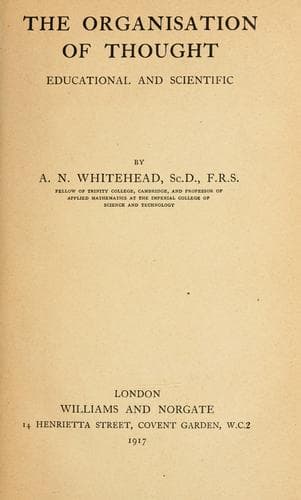
The organisation of thought, educational and scientificWhitehead, Alfred North
Philosophy
The organisation of thought, educational and scientific
Whitehead, Alfred North
Education
Given two, or more, propositional functions ƒ(_x_) and ϕ(_x_)
with the same argument _x_, we form derivative propositional
functions, namely,
ƒ(_x_) or ϕ(_x_), ƒ(_x_) or not-ϕ(_x_),
and so on with the contradictories, obtaining, as in the arithmetical
stage, an unending aggregate of propositional functions. Also each
propositional function yields two general propositions. The theory
of the interconnection between the truth-values of the general
propositions arising from any such aggregate of propositional functions
forms a simple and elegant chapter of mathematical logic.
In this algebraic section of logic the theory of types crops up, as we
have already noted. It cannot be neglected without the introduction of
error. Its theory has to be settled at least by some safe hypothesis,
even if it does not go to the philosophic basis of the question. This
part of the subject is obscure and difficult, and has not been finally
elucidated, though Russell's brilliant work has opened out the subject.
The final impulse to modern logic comes from the independent discovery
of the importance of the logic variable by Frege and Peano. Frege went
further than Peano, but by an unfortunate symbolism rendered his work
so obscure that no one fully recognised his meaning who had not found
it out for himself. But the movement has a large history reaching back
to Leibniz and even to Aristotle. Among English contributors are De
Morgan, Boole, and Sir Alfred Kempe; their work is of the first rank.
The third logical section is the stage of general-function theory.
In logical language, we perform in this stage the transition from
intension to extension, and investigate the theory of denotation. Take
the propositional function, ƒ(_x_). There is the class, or range
of values for _x_, whose members satisfy ƒ(_x_). But the same
range may be the class whose members satisfy another propositional
function ϕ(_x_). It is necessary to investigate how to indicate
the class by a way which is indifferent as between the various
propositional functions which are satisfied by any member of it, and of
it only. What has to be done is to analyse the nature of propositions
about a class--namely, those propositions whose truth-values depend on
the class itself and not on the particular meaning by which the class
is indicated.
Public-domain text, read in full here on John Shaqi.
Reviews
Reviews
No reviews yet
Be the first to share your thoughts on this work.
Elsewhere in the archive
Join the Discussion
Join the discussion
Sign in to leave a comment or review.
Sign InorCreate an account