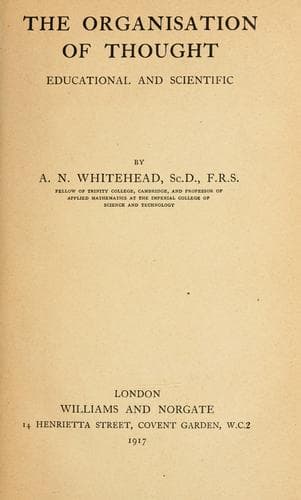
The organisation of thought, educational and scientificWhitehead, Alfred North
Philosophy
The organisation of thought, educational and scientific
Whitehead, Alfred North
Education
A more important question is the relation of induction, based on
observation, to deductive logic. There is a tradition of opposition
between adherents of induction and of deduction. In my view, it
would be just as sensible for the two ends of a worm to quarrel.
Both observation and deduction are necessary for any knowledge worth
having. We cannot get at an inductive law without having recourse to a
propositional function. For example, take the statement of observed
fact,
This body is mercury, and its specific heat is 0·033.
The propositional function is formed,
Either _x_ is not mercury, or its specific heat is 0·033.
The inductive law is the assumption of the truth of the general
proposition, that the above propositional function is true for every
value of _x_ in the relevant type.
But it is objected that this process and its consequences are so simple
that an elaborate science is out of place. In the same way, a British
sailor knows the salt sea when he sails over it. What, then, is the use
of an elaborate chemical analysis of sea-water? There is the general
answer, that you cannot know too much of methods which you always
employ; and there is the special answer, that logical forms and logical
implications are not so very simple, and that the whole of mathematics
is evidence to this effect.
One great use of the study of logical method is not in the region of
elaborate deduction, but to guide us in the study of the formation of
the main concepts of science. Consider geometry, for example. What are
the points which compose space? Euclid tells us that they are without
parts and without magnitude. But how is the notion of a point derived
from the sense-perceptions from which science starts? Certainly points
are not direct deliverances of the senses. Here and there we may see or
unpleasantly feel something suggestive of a point. But this is a rare
phenomenon, and certainly does not warrant the conception of space as
composed of points. Our knowledge of space properties is not based on
any observations of relations between points. It arises from experience
of relations between bodies. Now a fundamental space-relation between
bodies is that one body may be part of another. We are tempted to
define the "whole and part" relation by saying that the points occupied
by the part are some of the points occupied by the whole. But "whole
and part" being more fundamental than the notion of "point," this
definition is really circular and vicious.
Public-domain text, read in full here on John Shaqi.
Reviews
Reviews
No reviews yet
Be the first to share your thoughts on this work.
Elsewhere in the archive
Join the Discussion
Join the discussion
Sign in to leave a comment or review.
Sign InorCreate an account