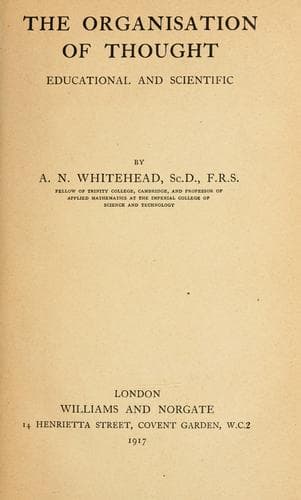
The organisation of thought, educational and scientificWhitehead, Alfred North
Philosophy
The organisation of thought, educational and scientific
Whitehead, Alfred North
Education
Analogous procedures are obviously possible for higher finite cardinal
members. Thus, step by step, the whole cycle of current mathematical
ideas is capable of logical definition. The process is detailed and
laborious, and, like all science, knows nothing of a royal road of
airy phrases. The essence of the process is, first, to construct
the notion in terms of the forms of propositions, that is, in terms
of the relevant propositional functions, and secondly, to prove the
fundamental truths which hold about the notion by reference to the
results obtained in the algebraic section of logic.
It will be seen that in this process the whole apparatus of special
indefinable mathematical concepts, and special _a priori_
mathematical premises, respecting number, quantity, and space, has
vanished. Mathematics is merely an apparatus for analysing the
deductions which can be drawn from any particular premises, supplied
by commonsense, or by more refined scientific observation, so far as
these deductions depend on the forms of the propositions. Propositions
of certain forms are continually occurring in thought. Our existing
mathematics is the analysis of deductions which concern those forms and
in some way are important, either from practical utility or theoretical
interest. Here I am speaking of the science as it in fact exists. A
theoretical definition of mathematics must include in its scope any
deductions depending on the mere forms of propositions. But, of course
no one would wish to develop that part of mathematics which in no sense
is of importance.
This hasty summary of logical ideas suggests some reflections. The
question arises, How many forms of propositions are there? The
answer is, An unending number. The reason for the supposed sterility
of logical science can thus be discerned. Aristotle founded the
science by conceiving the idea of the form of a proposition, and by
conceiving deduction as taking place in virtue of the forms. But he
confined propositions to four forms, now named A, I, E, O. So long as
logicians were obsessed by this unfortunate restriction, real progress
was impossible. Again, in their theory of form, both Aristotle and
subsequent logicians came very near to the theory of the logical
variable. But to come very near to a true theory, and to grasp its
precise application, are two very different things, as the history of
science teaches us. Everything of importance has been said before by
somebody who did not discover it.
Again, one reason why logical deductions are not obvious is, that
logical form is not a subject which ordinarily enters into thought.
Commonsense deduction probably moves by blind instinct from concrete
proposition to concrete proposition, guided by some habitual
association of ideas. Thus commonsense fails in the presence of a
wealth of material.
Public-domain text, read in full here on John Shaqi.
Reviews
Reviews
No reviews yet
Be the first to share your thoughts on this work.
Elsewhere in the archive
Join the Discussion
Join the discussion
Sign in to leave a comment or review.
Sign InorCreate an account