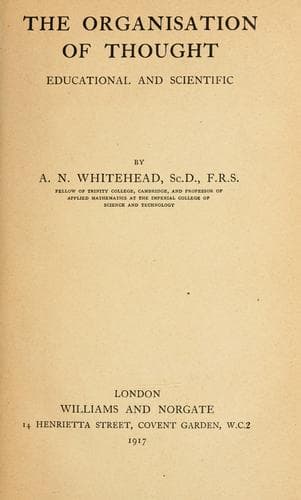
The organisation of thought, educational and scientificWhitehead, Alfred North
Philosophy
The organisation of thought, educational and scientific
Whitehead, Alfred North
Education
I will now break off the exposition of the function of logic in
connection with the science of natural phenomena. I have endeavoured
to exhibit it as the organising principle, analysing the derivation
of the concepts from the immediate phenomena, examining the structure
of the general propositions which are the assumed laws of nature,
establishing their relations to each other in respect to reciprocal
implications, deducing the phenomena we may expect under given
circumstances.
Logic, properly used, does not shackle thought. It gives freedom, and
above all, boldness. Illogical thought hesitates to draw conclusions,
because it never knows either what it means, or what it assumes, or
how far it trusts its own assumptions, or what will be the effect of
any modification of assumptions. Also the mind untrained in that part
of constructive logic which is relevant to the subject in hand will be
ignorant of the sort of conclusions which follow from various sorts of
assumptions, and will be correspondingly dull in divining the inductive
laws. The fundamental training in this relevant logic is, undoubtedly,
to ponder with an active mind over the known facts of the case,
directly observed. But where elaborate deductions are possible, this
mental activity requires for its full exercise the direct study of the
abstract logical relations. This is applied mathematics.
Neither logic without observation, nor observation without logic, can
move one step in the formation of science. We may conceive humanity
as engaged in an internecine conflict between youth and age. Youth is
not defined by years but by the creative impulse to make something. The
aged are those who, before all things, desire not to make a mistake.
Logic is the olive branch from the old to the young, the wand which in
the hands of youth has the magic property of creating science.
FOOTNOTES:
[Footnote 2: _E.g._ in 1551 by Italian schoolmen; cf. Sarpi's
_History of the Council of Trent_, under that date.]
CHAPTER VII
THE ANATOMY OF SOME SCIENTIFIC IDEAS
_I. Fact_
THE characteristic of physical science is, that it ignores all
judgments of value: for example, æsthetic or moral judgments. It is
purely matter-of-fact, and this is the sense in which we must interpret
the sonorous phrase, "Man, the servant and the minister of Nature."
Public-domain text, read in full here on John Shaqi.
Reviews
Reviews
No reviews yet
Be the first to share your thoughts on this work.
Elsewhere in the archive
Join the Discussion
Join the discussion
Sign in to leave a comment or review.
Sign InorCreate an account