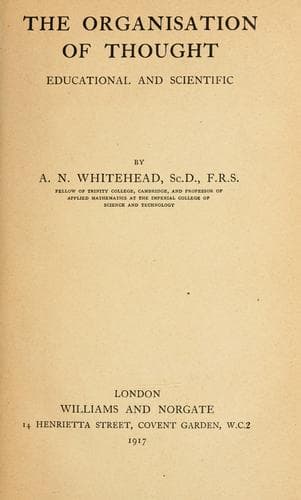
The organisation of thought, educational and scientificWhitehead, Alfred North
Philosophy
The organisation of thought, educational and scientific
Whitehead, Alfred North
Education
This is one of the fundamental principles of mental
construction according to which our conception of the external physical
world is constructed. Other examples will later on be met with.
The space-relations between the parts are confused and fluctuating,
and in general lack determinate precision. The master-key by which
we confine our attention to such parts as possess mutual relations
sufficiently simple for our intellects to consider is the principle of
convergence to simplicity with diminution of extent. We will call it
the "principle of convergence." This principle extends throughout the
whole field of sense-presentation.
The first application of the principle occurs in respect to time.
The shorter the stretch of time, the simpler are the aspects of the
sense-presentation contained within it. The perplexing effects of
change are diminished and in many cases can be neglected. Nature has
restricted the acts of thought which endeavour to realise the content
of the present, to stretches of time sufficiently short to secure this
static simplicity over the greater part of the sense-stream.
Spatial relations become simplified within the approximately static
sense-world of the short time. A further simplicity is gained by
partitioning this static world into parts of restricted space-content.
The various parts thus obtained have simpler mutual space-relations,
and again the principle of convergence holds.
Finally, the last simplicity is obtained by partitioning the
parts, already restricted as to space and time, into further parts
characterised by homogeneity in type of sense, and homogeneity in
quality and intensity of sense. These three processes of restriction
yield, finally, the sense-objects which have been mentioned above. Thus
the sense-object is the result of an active process of discrimination
made in virtue of the principle of convergence. It is the result of
the quest for simplicity of relations within the complete stream of
sense-presentation.
The thought-objects of perception are instances of a fundamental
law of nature, the law of objective stability. It is the law of the
coherence of sense-objects. This law of stability has an application
to time and an application to space; also it must be applied in
conjunction with that other law, the principle of convergence to
simplicity from which sense-objects are derived.
Public-domain text, read in full here on John Shaqi.
Reviews
Reviews
No reviews yet
Be the first to share your thoughts on this work.
Elsewhere in the archive
Join the Discussion
Join the discussion
Sign in to leave a comment or review.
Sign InorCreate an account