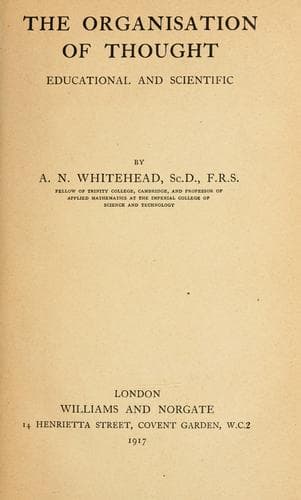
The organisation of thought, educational and scientificWhitehead, Alfred North
Philosophy
The organisation of thought, educational and scientific
Whitehead, Alfred North
Education
So, finally, we conceive ourselves each experiencing a complete
time-flux (or stream) of sense-presentation. This stream is
distinguishable into parts. The grounds of distinction are differences
of sense--including within that term, differences of types of sense,
and differences of quality and of intensity within the same type
of sense--and differences of time-relations, and differences of
space-relations. Also the parts are not mutually exclusive and exist in
unbounded variety.
The time-relation between the parts raises the questions of memory and
recognition, subjects too complex for discussion here. One remark must
be made. If it be admitted, as stated above, that we live in durations
and not in instants, namely, that the present essentially occupies
a stretch of time, the distinction between memory and immediate
presentation cannot be quite fundamental; for always we have with us
the fading present as it becomes the immediate past. This region of our
consciousness is neither pure memory nor pure immediate presentation.
Anyhow, memory is also a presentation in consciousness.
Another point is to be noted in connection with memory. There is no
directly perceived time-relation between a present event and a past
event. The present event is only related to the memory of the past
event. But the memory of a past event is itself a present element
in consciousness. We assert the principle that directly perceived
relations can only exist between elements of consciousness, both in
that present during which the perception occurs. All other relations
between elements of perception are inferential constructions. It thus
becomes necessary to explain how the time stream of events establishes
itself in thought, and how the apparent world fails to collapse into
one single present. The solution of the difficulty is arrived at
by observing that the present is itself a duration, and therefore
includes directly perceived time-relations between events contained
within it. In other words we put the present on the same footing as
the past and the future in respect to the inclusion within it of
antecedent and succeeding events, so that past, present, and future
are in this respect exactly analogous ideas. Thus there will be two
events _a_ and _b_, both in the same present, but the event
_a_ will be directly perceived to precede the event _b_.
Again time flows on, and the event _a_ fades into the past, and
in the new present duration events _b_ and _c_ occur, event
_b_ preceding event _c_, also in the same present duration
there is the memory of the time-relation between _a_ and _b_.
Then by an inferential construction the event _a_ in the past
precedes the event _c_ in the present. By proceeding according to
this principle the time-relations between elements of consciousness,
not in the same present, are established. The method of procedure
here explained is a first example of what we will call the Principle
of Aggregation.
Public-domain text, read in full here on John Shaqi.
Reviews
Reviews
No reviews yet
Be the first to share your thoughts on this work.
Elsewhere in the archive
Join the Discussion
Join the discussion
Sign in to leave a comment or review.
Sign InorCreate an account