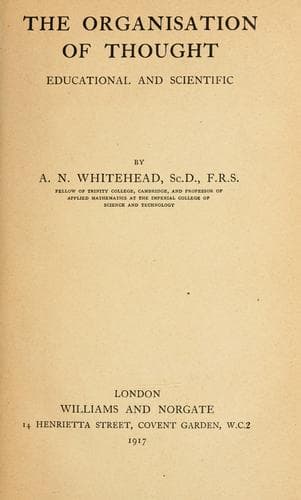
The organisation of thought, educational and scientificWhitehead, Alfred North
Philosophy
The organisation of thought, educational and scientific
Whitehead, Alfred North
Education
The essential ground of the association of sense-objects of
various types, perceived within one short duration, into a first
crude thought-object of perception is the coincidence of their
space-relations, that is, in general an approximate coincidence of
such relations perhaps only vaguely apprehended. Thus coincident
space-relations associate sense-objects into a first crude
thought-object, and diverse space-relations dissociate sense-objects
from aggregation into a first crude thought-object. In respect to
some groups of sense-objects the association may be an immediate
judgment devoid of all inference, so that the primary perceptual
thought is that of the first crude thought-object, and the separate
sense-objects are the result of reflective analysis acting on memory.
For example sense-objects of sight and sense-objects of touch are
often thus primarily associated and only secondarily dissociated in
thought. But sometimes the association is wavering and indeterminate,
for example, that between the sound-object of the mew of the cat and
the sight-object of the cat. Thus to sum up, the partial stream of
sense-perceptions coalesces into that first crude thought-object of
perception which is the momentary cat because the sense-perceptions
belonging to this stream are in the same place, but equally it would
be true to say that they are in the same place because they belong
to the same momentary cat. This analysis of the complete stream of
sense-presentation in any small present duration into a variety of
first crude thought-objects only partially fits the facts; for one
reason because many sense-objects, such as sound for instance, have
vague and indeterminate space-relations, for example vaguely those
space-relations which we associate with our organs of sense and also
vaguely those of the origin from which (in the scientific explanation)
they proceed.
The procedure by which the orange of half a minute is elaborated into
the orange in the ordinary sense of the term involves in addition the
two principles of aggregation and of hypothetical sense-presentation.
The principle of aggregation, as here employed, takes the form that
many distinct first crude thought-objects of perception are conceived
as one thought-object of perception, if the many partial streams
forming these objects are sufficiently analogous, if their times of
occurrence are distinct, and if the associated sense-presentations are
sufficiently analogous.
Public-domain text, read in full here on John Shaqi.
Reviews
Reviews
No reviews yet
Be the first to share your thoughts on this work.
Elsewhere in the archive
Join the Discussion
Join the discussion
Sign in to leave a comment or review.
Sign InorCreate an account