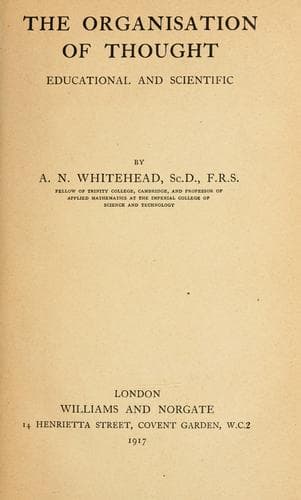
The organisation of thought, educational and scientificWhitehead, Alfred North
Philosophy
The organisation of thought, educational and scientific
Whitehead, Alfred North
Education
It will be found that a fourth condition is necessary owing to
logical difficulties connected with the theory of an infinite number
of choices. It will not be necessary for us to enter further on
this question, which involves difficult considerations of abstract
logic. The outcome is, that apart from hypothesis we cannot prove the
existence of the sets, each containing an infinite number of objects,
which are here called points, as will be explained immediately.
Now consider a set of enclosure objects which is such that (1)
of any two of its members one encloses the other, and (2) there
is no member which is enclosed by all the others, and (3) there
is no enclosure-object, not a member of the set which is enclosed
by every member of the set. Call such a set a "convergent set of
enclosure-objects." As we pass along the series from larger to smaller
members, evidently we converge towards an ideal simplicity to any
degree of approximation to which we like to proceed, and the series as
a whole embodies the complete ideal along that route of approximation.
In fact, to repeat, the series is a _route of approximation_.
We have now to inquire if the principle of convergence to simplicity
may be expected to yield the same type of simplicity for every such
convergent route. The answer is, as we might expect, namely, that this
depends upon the nature of the properties which are to be simplified.
For example, consider the application to time. Now, time is
one-dimensional; so when this property of one-dimensionality has been
expressed by the proper conditions, not here stated, a convergent set
of enclosure-objects must, considered as a route of approximation,
exhibit the properties of one unique instant of time, as ordinarily
conceived by the euclidean definition. Accordingly, whatever simplicity
is to be achieved by the application to time of the principle of
convergence to simplicity must be exhibited among the properties of
any such route of approximation.
For space, different considerations arise. Owing to its multiple
dimensions, we can show that different convergent sets of
enclosure-objects, indicating different routes of approximation, may
exhibit convergence to different types of simplicity, some more complex
than others.
For example, consider a rectangular box of height _h_ ft., breadth
_b_ ft., and thickness _c_ ft. Now, keep _h_ and _b_ constant, and
let the central plane (height _h_, breadth _b_) perpendicular to the
thickness be fixed, then make _c_ diminish indefinitely. We thus obtain
a convergent series of an indefinitely large number of boxes, and there
is no smallest box. Thus this convergent series exhibits the route of
approximation towards the type of simplicity expressed as being a plane
area of height _h_, breadth _b_, and no thickness.
Again, by keeping the central line of height _h_ fixed, and by making
_b_ and _c_ diminish indefinitely, the series converges to the segment
of a straight line of length _h_.
Public-domain text, read in full here on John Shaqi.
Reviews
Reviews
No reviews yet
Be the first to share your thoughts on this work.
Elsewhere in the archive
Join the Discussion
Join the discussion
Sign in to leave a comment or review.
Sign InorCreate an account