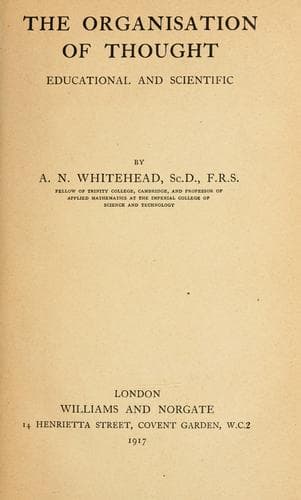
The organisation of thought, educational and scientificWhitehead, Alfred North
Philosophy
The organisation of thought, educational and scientific
Whitehead, Alfred North
Education
The subsequent explanations can be made easier to follow by a small
piece of symbolism: Let _aEb_ mean that "_b_ is part of _a_." We need
not decide whether we are talking of time-parts or space-parts, but
whichever choice is supposed to be made must be conceived as adhered to
throughout any connected discussion. The symbol _E_ may be considered
as the initial letter of "encloses," so we read "_aEb_" as "_a_
encloses _b_." Again the "field of _E_" is the set of things which
either enclose or are enclosed, _i. e._ everything "_a_," which is such
that _x_ can be found so that either _aEx_ or _xEa_. A member of the
field of _E_ is called "an enclosure-object."
Now, we assume that this relation of whole-to-part, which in the future
we will call "enclosure," always satisfies the conditions in that the
relation _E_ is (1) transitive, (2) asymmetrical, and (3) with its
domain including its converse domain.
These four conditions deserve some slight consideration; only the first
two of them embody hypotheses which enter vitally into the reasoning.
Condition (1) may be stated as the condition that _aEb_ and _bEc_
always implies _aEc_. The fact that an entity _b_ can be found such
that _aEb_ and _bEc_ may be conceived as a relation between _a_ and
_c_. It is natural to write _E_^2 for this relation. Thus the condition
is now written: If _aE_^2_c_, then _aEc_. This can be still otherwise
expressed by saying that the relation _E_^2 implies, whenever it holds,
that the relation _E_ also holds.
Condition (2) is partly a mere question of trivial definition, and
partly a substantial assumption. The asymmetrical relation (_E_) is
such that _aEb_ and _bEa_ can never hold simultaneously. This property
splits up into two parts: (1) that no instance of _aEb_ and _bEa_ and
"_a_ diverse from _b_," can occur, and (2) that _aEa_ cannot occur.
The first part is a substantial assumption, the second part (so far as
we are concerned) reduces to the trivial convention that we shall not
consider an object as part of itself, but will confine attention to
"proper parts."
Condition (3) means that _aEb_ always implies that _c_ can be
found such that _bEc_. This condition, taken in conjunction with
the fact that we are only considering proper parts, is the assertion of
the principle of the indefinite divisibility of extended objects, both
in space and in time.
An indivisible part will lack duration in time, and extension in
space, and is thus an entity of essentially a different character
to a divisible part. If we admit such indivisibles as the only true
sense-objects, our subsequent procedure is an unnecessary elaboration.
Public-domain text, read in full here on John Shaqi.
Reviews
Reviews
No reviews yet
Be the first to share your thoughts on this work.
Elsewhere in the archive
Join the Discussion
Join the discussion
Sign in to leave a comment or review.
Sign InorCreate an account