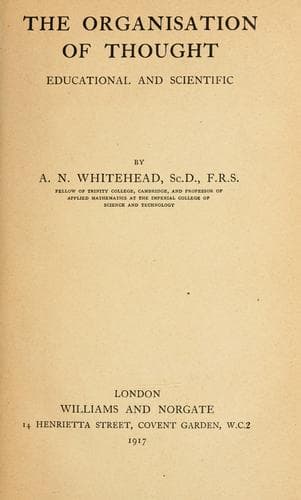
The organisation of thought, educational and scientificWhitehead, Alfred North
Philosophy
The organisation of thought, educational and scientific
Whitehead, Alfred North
Education
Modern science is really unconcerned with this debate. Its
(unacknowledged) conceptions are really quite different, though the
verbal explanations retain the form of a previous epoch. The point of
the change in conception is that the old thought-object of science was
conceived as possessing a simplicity not belonging to the material
universe as a whole. It was secluded within a finite region of space,
and changes in its circumstances could only arise from forces which
formed no essential part of its nature. An ether was called into
existence to explain the active relations between these passive
thought-objects. The whole conception suffers from the logical
difficulties noted above. Also no clear conception can be formed of
the sense in which the ether is explanatory. It is to possess a type
of activity denied to the original thought-object, namely, it carries
potential energy, whereas the atom possessed only kinetic energy,
the so-called potential energy of an atom belonging really to the
surrounding ether. The truth is, that ether is really excepted from the
axiom "no action at a distance," and the axiom thereby is robbed of all
its force.
The modern thought-object of science--not yet explicitly
acknowledged--has the complexity of the whole material universe. In
physics, as elsewhere, the hopeless endeavour to derive complexity
from simplicity has been tacitly abandoned. What is aimed at is not
simplicity, but persistence and regularity. In a sense regularity
is a sort of simplicity. But it is the simplicity of stable mutual
relations, and not the simplicity of absence of types of internal
structure or of type of relation. This thought-object fills all space.
It is a "field"; that is to say, it is a certain distribution of
scalar and vector quantities throughout space, these quantities having
each its value for each point of space at each point of time, being
continuously distributed throughout space and throughout time, possibly
with some exceptional discontinuities. The various types of quantity
which form the field have fixed relations to each other at each point
of time and space. These relations are the ultimate laws of nature.
Public-domain text, read in full here on John Shaqi.
Reviews
Reviews
No reviews yet
Be the first to share your thoughts on this work.
Elsewhere in the archive
Join the Discussion
Join the discussion
Sign in to leave a comment or review.
Sign InorCreate an account