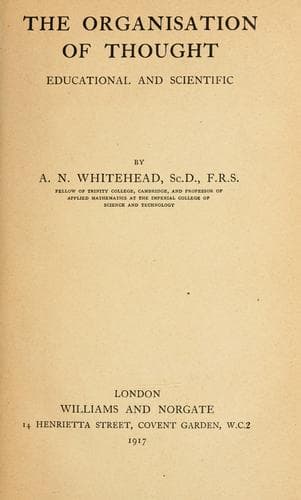
The organisation of thought, educational and scientificWhitehead, Alfred North
Philosophy
The organisation of thought, educational and scientific
Whitehead, Alfred North
Education
But in tracing the antecedents of events, commonsense thought, dealing
with the world of thought-objects of perception, habitually assumes
that the greater number of antecedent events can be neglected as
irrelevant. Consideration of causes is restricted to a few events
during a short preceding interval. Finally, in scientific thought it
has been assumed that the events in an arbitrarily small preceding
duration are sufficient. Thus physical quantities and their successive
differential co-efficients up to any order at the instant, but with
their limiting values just before that instant, are on this theory
sufficient to determine the state of the universe at all times after
the instant. More particular laws are assumed. But the search for
them is guided by this general principle. Also it is assumed that the
greater number of events in the physical universe are irrelevant to
the production of any particular effect, which is assumed to issue
from relatively few antecedents. These assumptions have grown out of
the experience of mankind. The first lesson of life is to concentrate
attention on few factors of sense-presentations, and on still fewer of
the universe of thought-objects of perception.
The principle by which--consciously or unconsciously--thought has been
guided is that in searching for particular causes, remoteness in time
and remoteness in space are evidences of comparative disconnection
of influence. The extreme form of this principle is the denial of
any action at a distance either in time or space. The difficulty in
accepting this principle in its crude form is, that since there are no
contiguous points, only coincident bodies can act on each other. I can
see no answer to this difficulty--namely, either bodies have the same
location and are thus coincident, or they have different locations and
are thus at a distance and do not act on each other.
This difficulty is not evaded by the hypothesis of an ether,
continuously distributed. For two reasons: in the first place, the
continuity of the ether does not avoid the dilemma; and secondly, the
difficulty applies to time as well as to space, and the dilemma would
prove that causation producing change is impossible, namely, no changed
condition could be the result of antecedent circumstances.
On the other hand, a direct interaction between two bodies separated
in space undoubtedly offends the conception of distance as implying
physical disconnection as well as spatial relation. There is no logical
difficulty in the assumption of action at a distance as in the case
of its denial, but it is contradictory to persistent assumptions of
that apparatus of commonsense thought which it is the main business
of science to harmonise with sense-presentation, employing only the
minimum of modification.
Public-domain text, read in full here on John Shaqi.
Reviews
Reviews
No reviews yet
Be the first to share your thoughts on this work.
Elsewhere in the archive
Join the Discussion
Join the discussion
Sign in to leave a comment or review.
Sign InorCreate an account