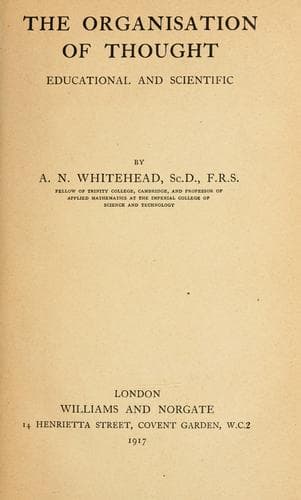
The organisation of thought, educational and scientificWhitehead, Alfred North
Philosophy
The organisation of thought, educational and scientific
Whitehead, Alfred North
Education
It is to be noted that the two alternative views of causation are
here both included. The complete field within any region of space
depends on the past histories of all the electrons, histories extending
backwards in proportion to their distances. Also this dependence can
be conceived as a transmission. But viewing the cause which effects
changes on the electron within that region, it is solely that field
within the region, which field is coincident with that electron both in
time and in space.
This process of conceiving the actuality underlying a possibility is
the uniform process by which regularity and permanence is introduced
into scientific thought, namely, we proceed from the actuality of the
fact to the actuality of possibility.
In conformity with this principle, propositions are the outgrowth
from actual thought-expressions, thought-objects of perceptions from
crude sense-objects, hypothetical thought-objects of perception from
actual thought-objects of perception, material points from hypothetical
infinite suites of hypothetical thought-objects of perception,
ideal points from material points, thought-objects of science from
thought-objects of perception, fields of electrons from actual mutual
reactions of actual electrons.
The process is a research for permanence, uniformity, and simplicity
of logical relation. But it does not issue in simplicity of internal
structure. Each ultimate thought-object of science retains every
quality attributed to the whole scientific universe, but retains them
in a form characterised by permanence and uniformity.
_V. Conclusion_
We commenced by excluding judgments of worth and ontological judgments.
We conclude by recalling them. Judgments of worth are no part of
the texture of physical science, but they are part of the motive of
its production. Mankind have raised the edifice of science, because
they have judged it worth while. In other words, the motives involve
innumerable judgments of value. Again, there has been conscious
selection of the parts of the scientific field to be cultivated, and
this conscious selection involves judgments of value. These values may
be æsthetic, or moral, or utilitarian, namely, judgments as to the
beauty of the structure, or as to the duty of exploring the truth, or
as to utility in the satisfaction of physical wants. But whatever the
motive, without judgments of value there would have been no science.
Again, ontological judgments were not excluded by reason of any lack
of interest. They are in fact presupposed in every act of life: in our
affections, in our self-restraints, and in our constructive efforts.
They are presupposed in moral judgments. The difficulty about them is
the absence of agreement as to the method of harmonising the crude
judgments of commonsense.
Public-domain text, read in full here on John Shaqi.
Reviews
Reviews
No reviews yet
Be the first to share your thoughts on this work.
Elsewhere in the archive
Join the Discussion
Join the discussion
Sign in to leave a comment or review.
Sign InorCreate an account