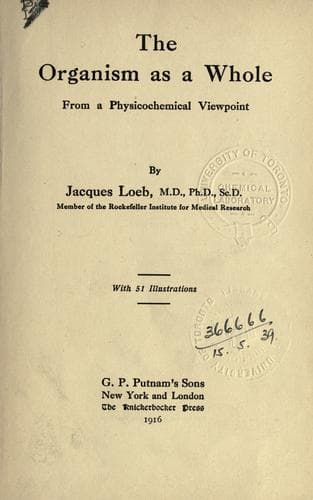
The Organism as a Whole, from a Physicochemical ViewpointLoeb, Jacques
Science
The Organism as a Whole, from a Physicochemical Viewpoint
Loeb, Jacques
Biology; Life (Biology); Mendel's law
It is hardly necessary to point out that in these cases we are
seemingly dealing with cases of the inhibition of growth which cannot
be explained by the tyranny of the whole over the parts, and that there
must be conditions at work other than the mere flow of substances which
can cause a cessation of growth. This can be illustrated by certain
observations on the egg.
8. The history of the egg shows a reversible condition of rest and
of activity. The primordial egg cell multiplies actively until a
large number of eggs are formed in the ovary which may reach into the
millions in the case of sea urchins or certain annelids. These cell
divisions then stop and the egg goes into the resting stage in which
it deposits the reserve material for the development of the embryo.
From this condition it can only be called into activity again by the
spermatozoön or the agencies of artificial parthenogenesis.
It seemed of interest to find out whether or not the development of
the egg may be reversed once more after it has been activated. From
all that has been said in the chapter on artificial parthenogenesis,
such a reversal should take place in the cortical layer. The result of
these experiments seems to be that if a complete destruction or change
in the cortical layer has once taken place--such as that caused by
the entrance of a spermatozoön into the egg--no reversal is possible;
although the development of the fertilized egg may be suppressed
for a long time by either low temperature or lack of oxygen, or, in
the case of seeds and spores, by lack of water. But as soon as the
conditions for the chemical reactions in the egg are normal again, the
development may go on unless the egg has suffered by the methods used
to prevent development or by the long duration of the suppression. With
an incomplete destruction of the cortical layer both development as
well as reversal of development are possible. Thus the writer has shown
that in the egg of _Arbacia_ the effect of the cortical alteration
of the egg induced by the butyric acid treatment or by the treatment
with bases can be reversed. When unfertilized eggs of _Arbacia_ are
put for from two to five minutes into 50 c.c. sea water + 2.0 c.c.
N/10 butyric acid they will all form a gelatinous, somewhat atypical
fertilization membrane; when put back into normal sea water all will
perish in a few hours unless they are submitted to the short treatment
with a hypertonic solution mentioned in the previous chapter, while if
submitted to this treatment they will develop. If, however, these eggs
are transferred from the butyric acid sea water not into normal sea
water but into sea water containing some NaCN (10 drops of 1/10 per
cent. NaCN or KCN in 50 c.c. sea water), and if they remain here for
some time (_e. g._ overnight) they will not perish when subsequently
transferred back to normal sea water. Such eggs will develop when
fertilized with sperm. The activating effect of the membrane formation
Public-domain text, read in full here on John Shaqi.
Reviews
Reviews
No reviews yet
Be the first to share your thoughts on this work.
Elsewhere in the archive
Join the Discussion
Join the discussion
Sign in to leave a comment or review.
Sign InorCreate an account