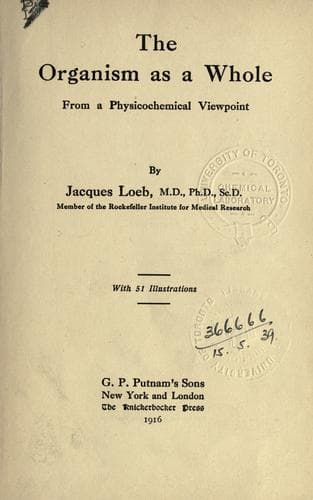
The Organism as a Whole, from a Physicochemical ViewpointLoeb, Jacques
Science
The Organism as a Whole, from a Physicochemical Viewpoint
Loeb, Jacques
Biology; Life (Biology); Mendel's law
The healing of a wound is a process essentially similar to the
regeneration of the lens. Normally the cells which begin to proliferate
after a wound is made in the skin lie dormant, inasmuch as they neither
grow nor divide. When a wound is made certain layers of epidermal
cells undergo rapid cell division. Leo Loeb[174] has studied this case
extensively. He found that if the skin is removed anywhere, epidermis
cells from the wound edge creep upon the denuded spot and form a
covering. This may be a tropism (stereotropism) or it may be a mere
surface tension phenomenon. Next a rapid process of cell division
begins in the cells adjacent to the wound these cells having been
heretofore dormant. He is inclined to attribute this increase in
the rate of cell division to the stretching of the epithelial cells,
and he is supported in this reasoning by the observation that the
larger the wound the more rapid the process of healing.[175] During
wound healing the mitoses first increase markedly in the old epithelium.
With the closure of the wound a sudden fall in the mitoses takes
place. The closure of the wound causes an increase in the number of
epithelial rows over the defect. This increase is therefore reached at
an earlier period in the larger wound since the process of mitosis is
more rapid here. Leo Loeb thinks that the pressure of the epithelial
cells upon each other leads to a rapid diminution in the mitotic
proliferation.[176]
[174] Loeb, Leo, _Arch. f. Entwcklngsmech._, 1898, vi., 297.
[175] Spain, K. C., and Loeb, Leo, _Jour. Exper. Med._, 1916, xxiii.,
107; Loeb, L., and Addison, W. H. F., _Arch. f. Entwcklngsmech._, 1911,
xxxii., 44; 1913, xxxvii., 635.
[176] The excessive formation of epithelial cells in the healing of
wounds has led the older pathologists to the generalization that if
something is removed in the body an excessive compensation will take
place. The formation of antibodies has even been explained on this
basis by Weiggert and Ehrlich in their side-chain theory. As a matter
of fact, this generalization is entirely incorrect and in regeneration
of starfish, actinians, flatworms, annelids, and possibly in all
forms the reverse is true; _e. g._, if we cut off the anterior half
of the body in _Cerianthus_ less is reproduced than was cut away
namely only tentacles and the mouth, but not the missing piece of the
body. Weiggert’s conception of regeneration was probably based on the
phenomenon of the healing of wounds, but the excessive epithelium
formation in this case is not the expression of a general law of
regeneration but of the peculiar mechanical conditions which lead to
mitoses. It would be a very strange coincidence indeed if a theory of
antibody formation based on such an erroneous generalization should be
correct.
Should it be possible that this is more generally the case, _e. g._,
also in the lens after it has reached a certain size? The conditions
limiting growth require further investigation.
Public-domain text, read in full here on John Shaqi.
Reviews
Reviews
No reviews yet
Be the first to share your thoughts on this work.
Elsewhere in the archive
Join the Discussion
Join the discussion
Sign in to leave a comment or review.
Sign InorCreate an account