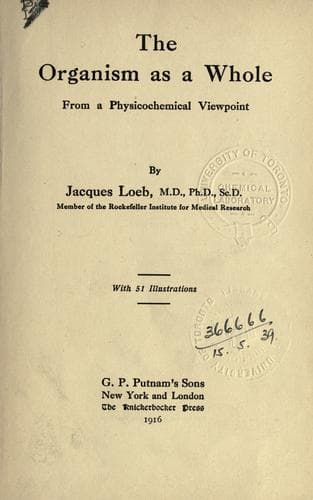
The Organism as a Whole, from a Physicochemical ViewpointLoeb, Jacques
Science
The Organism as a Whole, from a Physicochemical Viewpoint
Loeb, Jacques
Biology; Life (Biology); Mendel's law
One point might still be mentioned since it may help to overcome a
difficulty in visualizing the connection between the localization
of a factor in the chromosome and the production of a comparatively
large quantity of a specific chemical compound, _e. g._, a chromogen
or a tyrosinase. We must remember that all the cells of an organism
have identical chromosomes, so that a factor for an enzyme like
tyrosinase is contained in every cell throughout the whole body.
It is likely, however, that the same factor (which we may conceive
to be a definite chemical compound) will find a different chemical
substrate to work on in the cells of different organs of the body,
since the different organs differ in their chemical composition.
Thus it is conceivable that in the production of tyrosinase or of
tyrosine not a single chromomere of one single cell is engaged, but
the sum total of all these individual chromomeres of all the cells in
one or several organs of the body. The writer has added this remark
especially in consideration of the fact that some authors seem to feel
that the chromosome conception of heredity is incompatible with a
physicochemical view of this process.
Since we have mentioned this difficulty which some writers seem to
find in the chromosome theory of Mendelian heredity, it may be added
that a single factor may suffice to determine a series of complicated
reflexes. Thus the heliotropic reactions of animals are due to the
presence of photosensitive substances, and it suffices for the
hereditary transmission of the complicated purposeful reactions based
on these tropisms that a factor for the formation of the photosensitive
substance should exist.[215]
[215] Loeb, J., “Egg Structure and the Heredity of Instincts,” _The
Monist_, 1897, vii., 481.
5. Another point should be emphasized, namely that for Mendelian
heredity it is immaterial whether the character is introduced by the
spermatozoön or by the egg. This fact which Mendel himself already
recognized is in full harmony with the conclusion that the chromosomes
and not the cytoplasm are the bearers of Mendelian heredity, since only
in respect to the chromosome constitution are egg and sperm alike,
while they differ enormously in regard to the mass of protoplasm they
carry. We can, therefore, be tolerably sure that wherever we deal with
a hereditary factor which is determined by the egg alone the cytoplasm
of the latter is partly or exclusively responsible for the result.
We have already mentioned the fact that the rate of segmentation of
the egg is such a character. Yet this character is as definite as
any Mendelian character, and it would be as easy to discriminate two
species of eggs by the time required from insemination to the beginning
of cell division as it would be by any Mendelian character of their
parents.
Public-domain text, read in full here on John Shaqi.
Reviews
Reviews
No reviews yet
Be the first to share your thoughts on this work.
Elsewhere in the archive
Join the Discussion
Join the discussion
Sign in to leave a comment or review.
Sign InorCreate an account