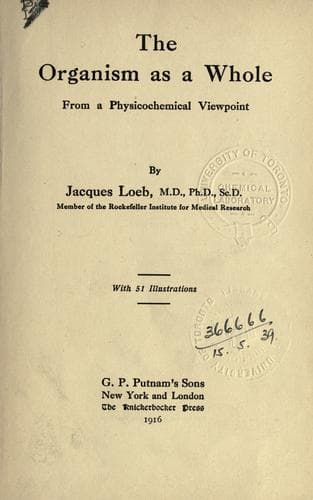
The Organism as a Whole, from a Physicochemical ViewpointLoeb, Jacques
Science
The Organism as a Whole, from a Physicochemical Viewpoint
Loeb, Jacques
Biology; Life (Biology); Mendel's law
The application of our modern knowledge of heredity to human affairs
has been discussed in a very original way by Bateson in his address
before the British Association in Sydney to which the reader may be
referred.[216]
[216] Bateson, W., _Nature_, 1916, xciii., 674.
CHAPTER X
ANIMAL INSTINCTS AND TROPISMS[217]
1. The idea that the organism as a whole cannot be explained from
a physicochemical viewpoint rests most strongly on the existence
of animal instincts and will. Many of the instinctive actions are
“purposeful,” _i. e._, assisting to preserve the individual and the
race. This again suggests “design” and a designing “force,” which we do
not find in the realm of physics. We must remember, however, that there
was a time when the same “purposefulness” was believed to exist in the
cosmos where everything seemed to turn literally and metaphorically
around the earth, the abode of man. In the latter case, the
anthropo- or geocentric view came to an end when it was shown that the
motions of the planets were regulated by Newton’s law and that there was
no room left for the activities of a guiding power. Likewise, in the
realm of instincts when it can be shown that these instincts may be
reduced to elementary physicochemical laws the assumption of design
becomes superfluous.
[217] Ideas similar to those expressed in this chapter may be found
in the writer’s former book _Comparative Physiology of the Brain and
Comparative Psychology_, New York, 1900, and in the books by George
Bohn, _La Naissance de l’Intelligence_, Paris, 1909, and _La nouvelle
Psychologie animale_, Paris, 1911.
If we look at the animal instincts purely as observers we might well
get the impression that they cannot be explained in mechanistic terms.
We need only consider what mysticism apparently surrounds all those
instincts by which the two sexes are brought together and by which the
entrance of the spermatozoön into the egg is secured; or the remarkable
instincts which result in providing food and shelter for the young
generation.
We have already had occasion to record some cases of instincts which
suggest the possibility of physicochemical explanation; for example the
curious experiment of Steinach on the reversal of the sexual instincts
of the male whose testes had been exchanged for ovaries. There is
little doubt that in this case the sexual activities of each sex are
determined by specific substances formed in the interstitial tissue of
the ovary and testes. The chemical isolation of the active substances
and an investigation of their action upon the various parts of the body
would seem to promise further progress along this line.
Public-domain text, read in full here on John Shaqi.
Reviews
Reviews
No reviews yet
Be the first to share your thoughts on this work.
Elsewhere in the archive
Join the Discussion
Join the discussion
Sign in to leave a comment or review.
Sign InorCreate an account