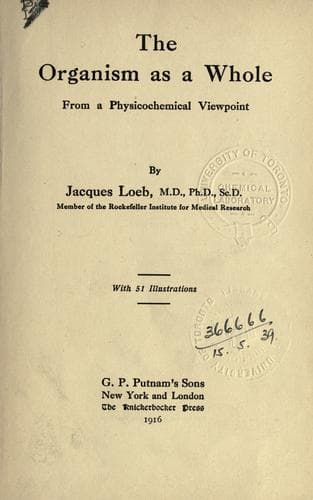
The Organism as a Whole, from a Physicochemical ViewpointLoeb, Jacques
Science
The Organism as a Whole, from a Physicochemical Viewpoint
Loeb, Jacques
Biology; Life (Biology); Mendel's law
The “attraction” or “repulsion” of animals by the light had been
explained by the biologists in an anthropomorphic way by ascribing to
the animals a “fondness” for light or for darkness. Thus Graber, who
had made the most extensive experiments, gave as a result the statement
that animals which are fond of light are also fond of blue while they
hate the red, and those which are fond of the “dark” are fond of red
and hate the blue.[218] In 1888 the writer published a paper in which
he pointed out that the so-called fondness of animals for light and
blue and for dark and red was simply a case of an automatic orientation
of animals by the light comparable to the turning of the tips of a
plant towards the window of the room in which the plant is raised.[219]
[218] Graber, V., _Grundlinien zur Erforschung des Helligkeits- und
Farbensinnes der Tiere_. Prag, 1884.
[219] Loeb, J., _Sitzungsber. d. physik.-med. Gesellsch_. Würzburg,
1888. _Der Heliotropismus der Tiere und seine Übereinstimmung mit
dem Heliotropismus der Pflanzen._ Würzburg, 1889. _Arch. f. d. ges.
Physiol._, 1897, lxvi., 439.
The phenomenon of a plant bending or growing to the source of light is
called positive heliotropism (while we speak of negative heliotropism
in all cases in which the plant turns away from the light, as is
observed in many roots). The writer pointed out that animals which go
to the light are positively heliotropic (or phototropic) and do so
because they are compelled automatically by the light to move in this
direction, while he called those animals which move away from the light
negatively heliotropic; they are automatically compelled by the light
to move away from it. What the light does is to direct the motions of
the animals and to explain this the following theory was proposed.
Animals possess photosensitive elements on the surface of their bodies,
in the eyes, or occasionally also in epithelial cells of their skin.
These photosensitive elements are arranged symmetrically in the body
and through nerves are connected with symmetrical groups of muscles.
The light causes chemical changes in the eyes (or the photosensitive
elements of the skin). The mass of photochemical reaction products
formed in the retina (or its homologues) influences the central
nervous system and through this the tension or energy production of
the muscles. If the rate of photochemical reaction is equal in both
eyes this effect on the symmetrical muscles is equal, and the muscles
of both sides of the body work with equal energy; as a consequence
the animal will not be deviated from the direction in which it was
moving. This happens when the axis or plane of symmetry of the animal
goes through the source of light, provided only one source of light
be present. If, however, the light falls sidewise upon the animal,
the rate of photochemical reaction will be unequal in both eyes and
the rate at which the symmetrical muscles of both sides of the body
Public-domain text, read in full here on John Shaqi.
Reviews
Reviews
No reviews yet
Be the first to share your thoughts on this work.
Elsewhere in the archive
Join the Discussion
Join the discussion
Sign in to leave a comment or review.
Sign InorCreate an account