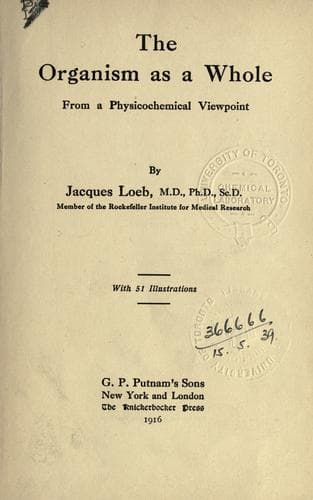
The Organism as a Whole, from a Physicochemical ViewpointLoeb, Jacques
Science
The Organism as a Whole, from a Physicochemical Viewpoint
Loeb, Jacques
Biology; Life (Biology); Mendel's law
Marchal’s observations on the laying of eggs by the naturally sterile
worker wasps are a similar case. The fact that such workers lay
eggs when the queen is removed or when they are taken away from the
larvæ may be considered as a manifestation of one of those wonderful
instincts which form the delight of readers of Maeterlinck’s romances
from insect life. Imagine the social foresight of the sterile workers
who when the occasion demands it “raise” eggs to preserve the stock
from extinction! And yet what really happens is that these workers,
when there are no larvæ, can consume the food which would otherwise
have been devoured by the larvæ; and some substance contained in
this food induces the development of eggs in the otherwise dormant
ovaries. What appeared at first sight as a mysterious social instinct
is revealed as an effect comparable to that of thyroid substance upon
the growth of the legs of tadpoles in Gudernatsch’s experiment (Chapter
VII).
2. If we wish to show in an unmistakable way the mechanistic character
of instincts we must be able to reduce them to laws which are also
valid in physics. That instinct, or rather that group of instincts,
for which this has been accomplished are the reactions of organisms
to light. The reader is familiar with the tendency of many insects to
fly into the flame. It can be shown that many species of animals, from
the lowest forms up to the fishes, are at certain stages--very often
the larval stage--of their existence, slaves of the light. When such
animals, _e. g._, the larvæ of the barnacle or certain winged plant
lice or the caterpillars of certain butterflies, are put into a trough
or test-tube illuminated from one side only, they will rush to the
side from which the light comes and will continue to do this whenever
the orientation of the trough or test-tube to the light is changed;
while they will be held at the window side of the vessel if the light
or the position of the vessel remains unchanged. This instinct to get
to the source of light is so strong that, _e. g._, the caterpillars of
_Porthesia chrysorrhœa_ die of starvation on the window side of the
vessel, with plenty of food close behind. This powerful “instinct”
is, as we intend to show, in the last analysis, the expression of
the Bunsen-Roscoe law of photochemical reactions. A large number
of chemical reactions are induced or accelerated by light, and the
Bunsen-Roscoe law shows that the chemical effect is in these cases,
within certain limits, equal to the product of the intensity into the
duration of illumination.
Public-domain text, read in full here on John Shaqi.
Reviews
Reviews
No reviews yet
Be the first to share your thoughts on this work.
Elsewhere in the archive
Join the Discussion
Join the discussion
Sign in to leave a comment or review.
Sign InorCreate an account