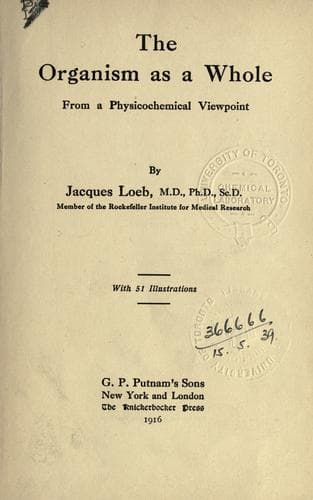
The Organism as a Whole, from a Physicochemical ViewpointLoeb, Jacques
Science
The Organism as a Whole, from a Physicochemical Viewpoint
Loeb, Jacques
Biology; Life (Biology); Mendel's law
The sensitive area which forms the basis of tropisms is as a rule
developed not in the whole organism but only in certain segments of the
body. Thus the eyes are located in the head. But when the action of one
segment becomes overpowering the whole organism follows the segment.
It has been customary among physiologists to speak of reflexes in such
cases. Thus, _e. g._, the arms of the male frog develop a powerful
positive stereotropism on their ventral surface during the spawning
season. It would avoid confusion to realize that there is nothing
gained in applying to this tropism the meaningless term “reflex”;
it is better to call them tropisms since the organism as a whole is
involved. If necessary we might speak of segmental tropisms. The act of
seeking the female as well as that of cohabitation are in many cases
combinations of chemotropism and stereotropism. The development of
these tropisms depends upon the presence of certain specific substances
in the body, a fact emphasized already in the case of heliotropism.
In case of the development of the segmental stereotropism of the male
frog at the time of spawning it has been shown that it depends on an
internal secretion from the testes.
It has been suggested by some authors that the tropistic reactions are
determined by some feeling or emotion on the part of the organism.
We have no means of judging the emotions of lower animals (except
by “intuition”). The writer suggested in 1899 in his book on brain
physiology that emotions may be determined by specific substances
which also determine the tropistic reaction (as well as phenomena of
organ formation, although this latter phenomenon has nothing to do
with the subject of instincts); and the excellent work of Cannon[246]
has shown the rôle of adrenalin in the expression of fear. It is,
therefore, both unwarranted and unnecessary to state that hypothetical
emotions determine the tropistic reactions.
[246] Cannon, W. B., _Bodily Changes in Pain, Hunger, Fear, and Rage_,
New York, 1915.
CHAPTER XI
THE INFLUENCE OF ENVIRONMENT
Public-domain text, read in full here on John Shaqi.
Reviews
Reviews
No reviews yet
Be the first to share your thoughts on this work.
Elsewhere in the archive
Join the Discussion
Join the discussion
Sign in to leave a comment or review.
Sign InorCreate an account