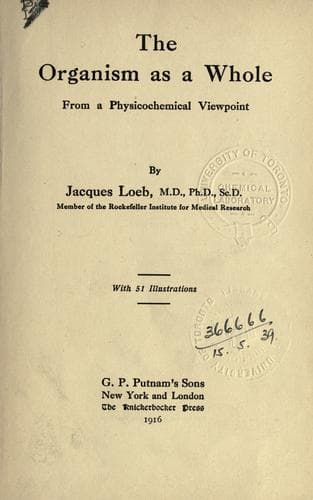
The Organism as a Whole, from a Physicochemical ViewpointLoeb, Jacques
Science
The Organism as a Whole, from a Physicochemical Viewpoint
Loeb, Jacques
Biology; Life (Biology); Mendel's law
1. The term environment in relation to an organism may easily assume
a mystic rôle if we assume that it can modify the organisms so that
they become adapted to its peculiarities. Such ideas are difficult
to comprehend from a physicochemical viewpoint, according to which
environment cannot affect the living organism and non-living matter in
essentially different ways. Of course we know that proteins will as a
rule coagulate at temperatures far below the boiling point of water
and that no life is conceivable for any length of time at temperatures
above 100° C., but heat coagulation of proteins occurs as well in
the test-tube as in the living organism. If we substitute for the
indefinite term environment the individual physical and chemical forces
which constitute environment it is possible to show that the influence
of each of these forces upon the organism finds its expression in
simple physicochemical laws and that there is no need to introduce any
other considerations.
We select for our discussion first the most influential of external
conditions, namely temperature. The reader knows that there is a
lower as well as an upper temperature limit for life. Setchell
has ascertained that in hot springs whose temperature is 43° C.,
or above, no animals or green alga are found.[247] In hot springs
whose temperature is above 43° he found only the _Cyanophyceæ_,
whose structure is more closely related to that of the bacteria
than to that of the algæ, inasmuch as they have neither definitely
differentiated nuclei nor chromophores. The highest temperature at
which _Cyanophyceæ_ occurred was 63° C. Not all the _Cyanophyceæ_
were able to stand temperatures above 43° C., but only a few species.
The other _Cyanophyceæ_ were found at a temperature below 40° C., and
were no more able to stand higher temperatures than the real algæ or
animals. The _Cyanophyceæ_ of the hot springs were as a rule killed
by a temperature of 73°. From this we must conclude that they contain
proteins whose coagulation temperature lies above that of animals and
green plants, and may be as high as 73°. Among the fungi many forms can
resist a temperature above 43° or 45°; the spores can generally stand
a higher temperature than the vegetative organs. Duclaux found that
certain bacilli (Tyrothrix) found in cheese are killed in one minute
at a temperature of from 80° to 90°; while for the spores of the same
bacillus a temperature of from 105° to 120° was required.[248]
[247] Setchell, W. A., _Science_, 1903, xxvii., 934.
[248] Duclaux, E., _Traité de microbiol._, 1898, i., 280.
Public-domain text, read in full here on John Shaqi.
Reviews
Reviews
No reviews yet
Be the first to share your thoughts on this work.
Elsewhere in the archive
Join the Discussion
Join the discussion
Sign in to leave a comment or review.
Sign InorCreate an account