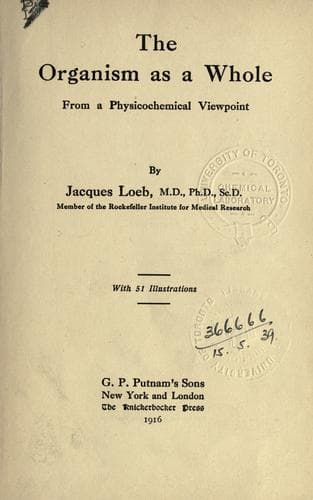
The Organism as a Whole, from a Physicochemical ViewpointLoeb, Jacques
Science
The Organism as a Whole, from a Physicochemical Viewpoint
Loeb, Jacques
Biology; Life (Biology); Mendel's law
The fact, that by slowly raising the concentration to 10/8 m the fish
may resist this limit, is in reality no adaptation. There is no sharp
limit between the injurious and non-injurious concentration. We have
seen that the fish is naturally immune to a 9/8 m solution. It is also
naturally immune to a 10/8 m or 11/8 m solution if we give it time to
compensate the injurious effects of a 10/8 m solution by the repairing
action of its blood or kidneys. Beyond this no rise is possible. In
reality adaptation does not exist in this case.
In former experiments the writer had shown that a pure NaCl solution
of that concentration in which this fish naturally lives kills it
very rapidly, while it lives in such a solution indefinitely if a
little CaCl₂ is added. The explanation of this fact is that the pure
NaCl solution is able to diffuse into the tissues of the animal while
the addition of a trace of CaCl₂ renders the membrane practically
impermeable to NaCl. The question then arose whether it was possible to
make the fish more resistant to a pure NaCl solution of sufficiently
high concentration and how this could be done. On the basis of the
idea of an adaptive effect of the environment we should expect that by
gradually raising the concentration of a pure NaCl solution the latter
would gradually alter the animal and make it more resistant. The method
of procedure suggested was therefore to put the fish first in low and
gradually into increasing concentrations of NaCl. This method was tried
and found futile for the purpose. _Fundulus_ when put from sea water
(after having been washed) into a 6/8 m NaCl solution die in about
four hours. When kept previously in a weaker NaCl solution they die if
anything more quickly. But it is possible to make them live longer
in a 6/8 m solution of NaCl; we have to proceed, however, by a method
which is in contrast with the ideas of the adaptive influence of the
environment. When the fish are first treated with sea water (or with
a mixture of NaCl+KCl+CaCl₂) of a higher concentration so that they
become adapted to a 10/8 m solution of NaCl+KCl+CaCl₂ or to 10/8 m sea
water, they become also more resistant to an otherwise toxic solution
of NaCl. Fish taken directly from sea water were killed in less than
four hours when put into a 6/8 m NaCl solution, while fish of the same
lot previously adapted to 10/8 m sea water in the manner described
above lived two or three days in a 6/8 m NaCl solution.[282]
[282] Loeb, J., _Biochem. Ztschr._, 1913, liii., 391.
It is not impossible that it was the high concentration of calcium
in the 10/8 m sea water which rendered the fish more immune to a
subsequent treatment with NaCl. We know why a pure NaCl solution kills
them and we also know why the addition of CaCl₂ protects them against
this pernicious effect. It is rather strange that where the conditions
of the experiments are clear we find nothing to indicate an adaptive
effect of the environment.
Public-domain text, read in full here on John Shaqi.
Reviews
Reviews
No reviews yet
Be the first to share your thoughts on this work.
Elsewhere in the archive
Join the Discussion
Join the discussion
Sign in to leave a comment or review.
Sign InorCreate an account