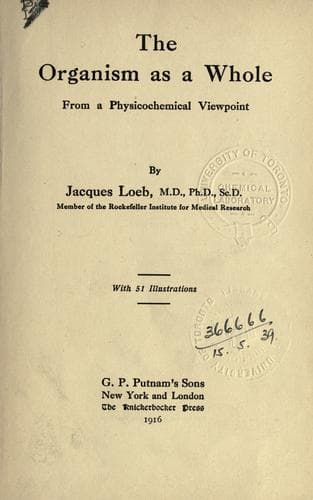
The Organism as a Whole, from a Physicochemical ViewpointLoeb, Jacques
Science
The Organism as a Whole, from a Physicochemical Viewpoint
Loeb, Jacques
Biology; Life (Biology); Mendel's law
4. Ehrlich’s work on trypanosomes seems to indicate a remarkable
power of adaptation on the part of organisms to certain poisons. If
the writer understands these experiments correctly they consisted
in infecting a mouse with a certain strain of trypanosomes, and
treating it with a certain arsenic compound, which inhibited somewhat
the propagation of the parasites but did not kill them all. Four or
five days later trypanosomes from this mouse were transmitted to
another mouse and after twenty-four hours this mouse was treated with
a stronger dose of the same arsenic compound; and this process was
repeated. After the third transmission or later, the trypanosomes can
resist considerably higher doses of the same poison than at first and
this resistance is retained for years. Ehrlich seems to have taken
it for granted that he had succeeded in transforming the surviving
trypanosomes into a type which is permanently more resistant to the
arsenic compound than was the original strain.
The writer is not entirely convinced that in these experiments
a possibility was sufficiently considered which is suggested by
Johannsen’s experiments on the importance of pure lines in work on
heredity. According to this author a strain of trypanosomes taken at
random should, in all likelihood, contain a population consisting of
strains with different degrees of resistance. If a high but not the
maximal concentration of an arsenic compound is repeatedly injected
into the infected mice the weaker populations of trypanosomes are
killed and only the more resistant survive. These of course continue to
retain their resistance if transplanted to hosts of the same species.
According to this interpretation the arsenic-fast strain may possibly
have existed before the experiments were made, and Ehrlich’s treatment
consisted only in eliminating the less resistant strains.
On the other hand, it has been shown that if an arsenic-fast strain
of trypanosomes is carried through a tsetse fly it loses its
arsenic-fastness. This fact may possibly eliminate the applicability
of the pure line theory to a discussion of the nature of the
arsenic-fastness, but it seems that further experiments are desirable.
Public-domain text, read in full here on John Shaqi.
Reviews
Reviews
No reviews yet
Be the first to share your thoughts on this work.
Elsewhere in the archive
Join the Discussion
Join the discussion
Sign in to leave a comment or review.
Sign InorCreate an account