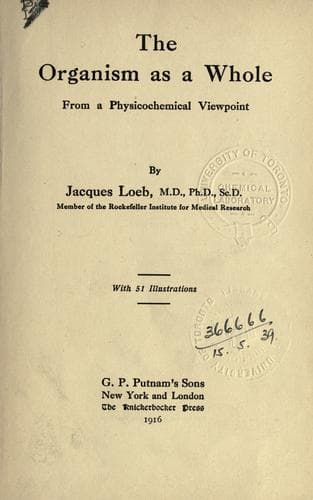
The Organism as a Whole, from a Physicochemical ViewpointLoeb, Jacques
Science
The Organism as a Whole, from a Physicochemical Viewpoint
Loeb, Jacques
Biology; Life (Biology); Mendel's law
While the writer does not decline to accept Ehrlich’s interpretation
of the arsenic-fast strains of trypanosomes or Kammerer’s statements
in regard to the inheritance of acquired character, he feels that more
work should be done before they can be used for our problem.
7. This attitude leaves us in a quandary. The whole animated world is
seemingly a symphony of adaptation. We have mentioned already the eye
with its refractive media so well curved and placed that a more or
less perfect image of the outside objects is focussed exactly on the
retina; and this in spite of the fact that lens and retina develop
independently; we have mentioned and discussed the cases of instincts
or automatic arrangements which are required to perpetuate life--the
attraction of the two sexes and the automatic mechanisms by which sperm
and egg are brought together; the maternal instincts by which the
young are taken care of; and all those adaptations by which animals
get their food and the suitable conditions of preservation. Can we
understand all these adaptations, without a belief in the heredity
of acquired characters? As a matter of fact the tenacity with which
some authors cling to such a belief is dictated by the idea that
this is the only alternative to the supra-naturalistic or vitalistic
ideas. The writer is of the opinion that we do not need to depend
upon the assumption of the heredity of acquired characters, but that
physiological chemistry is adequate for this purpose.
The earlier writers explained the growth of the legs in the tadpole of
the frog or toad as a case of an adaptation to life on land. We know
through Gudernatsch that the growth of the legs can be produced at
any time even in the youngest tadpole, which is unable to live on the
land, by feeding the animal with the thyroid gland. As we have stated
in Chapter VII, it is quite possible that in nature the legs of the
tadpole begin to grow when enough of the thyroid or a similar compound
has been formed or is circulating in the animal.
It might justly be claimed as a case of adaptation that the egg
attaches itself to the wall of the uterus and calls forth the formation
of the decidua. We have mentioned the observation of Leo Loeb that the
corpus luteum of the ovary gives off a substance to the blood which
alters the tissues in the uterus in such a way that contact with any
foreign body (_e. g._, the egg) induces this decidua formation. Again
what appeared as adaptation when unknown turns out to be a result of
the action of a definite chemical substance circulating in the body.
It appears as a case of adaptation that the eggs of the majority of
animals cannot develop without a spermatozoön, and yet we can imitate
the activating effect of a spermatozoön on the egg by definite chemical
compounds, which leads to the suggestion that the activating effect of
the spermatozoön on the egg might be due to the fact that it carries
such a compound.
Public-domain text, read in full here on John Shaqi.
Reviews
Reviews
No reviews yet
Be the first to share your thoughts on this work.
Elsewhere in the archive
Join the Discussion
Join the discussion
Sign in to leave a comment or review.
Sign InorCreate an account