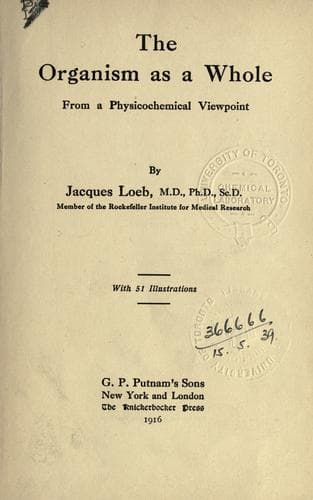
The Organism as a Whole, from a Physicochemical ViewpointLoeb, Jacques
Science
The Organism as a Whole, from a Physicochemical Viewpoint
Loeb, Jacques
Biology; Life (Biology); Mendel's law
The wonderful adaptations exhibited in the mating instincts seem to be
due to definite substances secreted by the sex glands, as was shown
by Steinach (Chapter VII). Here, again, the process as popularly
conceived, is the reverse of the truth; those survive that have the
equipment,--they did not acquire the equipment under the influence of
environment.
It is absolutely imperative for green plants that their stems and
leaves be exposed to the light since only in this way are they able
to form carbohydrates; and it is equally essential that the roots
should grow into the soil so that the plant may get the nitrates and
phosphates required to build up its proteins and nucleins. This result
is, in the language of adaptationists, brought about by an adaptive
response of the plant to the light. In reality this adaptive response
is due (Chapter X) to the presence of a photosensitive substance
present in almost all green plants.
Lewis has shown that if the optic cup is transplanted under the skin of
a young larva into any part of the body the skin in contact with the
optic cup will form a lens; it looks as if a chemical substance from
the optic cup were responsible for the formation of the lens.
These examples might be multiplied indefinitely. They all indicate that
apparent morphological and instinctive adaptations are merely caused
by chemical substances formed in the organism and that there is no
reason for postulating the inheritance of acquired characters. We must
not forget that there are just as many cases where chemical substances
circulating in the body lead to indifferent or harmful results. As an
example of the first type, we may mention the existence of heliotropism
in animals living in the dark, of the latter type, the inheritance of
deficiencies like colour-blindness or glaucoma.
While it is possible for forms with moderate disharmonies to survive,
those with gross disharmonies cannot exist and we are not reminded
of their possible existence. As a consequence the cases of apparent
adaptation prevail in nature.
Public-domain text, read in full here on John Shaqi.
Reviews
Reviews
No reviews yet
Be the first to share your thoughts on this work.
Elsewhere in the archive
Join the Discussion
Join the discussion
Sign in to leave a comment or review.
Sign InorCreate an account