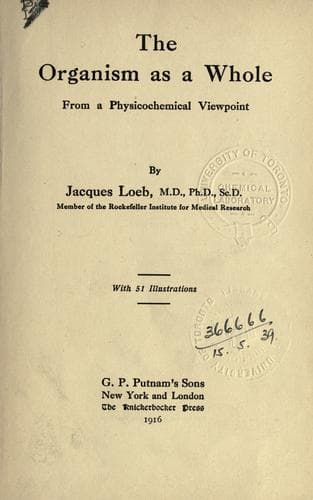
The Organism as a Whole, from a Physicochemical ViewpointLoeb, Jacques
Science
The Organism as a Whole, from a Physicochemical Viewpoint
Loeb, Jacques
Biology; Life (Biology); Mendel's law
The following observation may serve to give an idea how small is
the number of existing or durable forms compared with the number of
forms incapable of existence. We have mentioned the fact observed by
Moenkhouse, the writer, and Newman, that it is possible to fertilize
the eggs of each marine bony fish with the sperm of practically every
other marine bony fish. The number of teleosts at present in existence
is about ten thousand. If we accomplish all possible hybridizations,
one hundred million different crosses will result. Of these only a
small fraction of one per cent. can live (see Chapter I), and it is
generally the lack of a proper circulation which inhibits them from
reaching maturity. It is, therefore, no exaggeration to state that the
number of species existing today is only an extremely small fraction of
those which can and possibly do originate, but which escape our notice
and disappear because they cannot live or reproduce. If we consider
these facts we realize that the mere laws of chance are adequate to
account for the fact of the apparently purposeful adaptations; as they
are adequate to account for the Mendelian numbers.
CHAPTER XIII
EVOLUTION
Darwin’s work has been compared to that of Copernicus and Galileo
inasmuch as all these men freed the mind from the incubus of
Aristotelian philosophy which, with the efficient co-operation of the
church and the predatory system of economics, caused the stagnation,
squalor, immorality, and misery of the Middle Ages. Copernicus and
Galileo were the first to deliver the intellect from the idea of
a universe created for the purpose of man; and Darwin rendered a
similar service by his insistence that accidental and not purposeful
variations gave rise to the variety of organisms. In this struggle for
intellectual freedom the names of Huxley and Haeckel must be gratefully
remembered, since without them Darwin’s idea would not have conquered
humanity.
Darwin assumed that the small fluctuating variations could accumulate
to larger variations and thus cause new forms to originate.
Public-domain text, read in full here on John Shaqi.
Reviews
Reviews
No reviews yet
Be the first to share your thoughts on this work.
Elsewhere in the archive
Join the Discussion
Join the discussion
Sign in to leave a comment or review.
Sign InorCreate an account