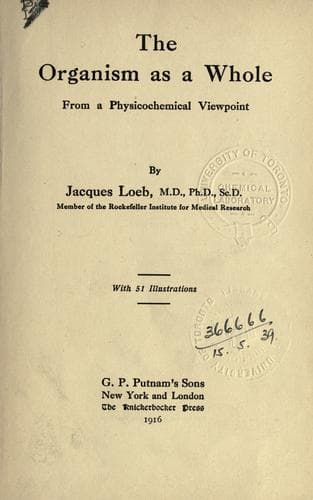
The Organism as a Whole, from a Physicochemical ViewpointLoeb, Jacques
Science
The Organism as a Whole, from a Physicochemical Viewpoint
Loeb, Jacques
Biology; Life (Biology); Mendel's law
These facts may help us to understand the nature of death and
dissolution of the body in higher animals. Death in these animals is
due to cessation of oxidations, but the surprising fact is that if
the oxidations have been interrupted but a few minutes life cannot
be restored even by artificial respiration. This suggests that the
respiratory ganglia in the medulla oblongata suffer an irreparable
injury or an irreversible change (comparable to that just described in
the cells of _Ctenolabrus_) even when deprived of oxygen for only a
short time. As a consequence of the irreversible injury to the medulla
the respirations cease permanently, the heart-beat must also cease,
and gradually the different tissues must undergo the dissolution
characteristic of death. While all the cells may be immortal they are
only so in the presence of oxygen and the nutritive solution which the
circulating blood furnishes. With the proper supply of oxygen cut off
they can no longer live.
4. It is an unquestionable fact that each form has a quite definite
duration of life. Unicellular organisms are immortal; but for the
higher organisms with sexual reproduction the duration of life is
almost as characteristic as any morphological peculiarity of a species.
No species can exist unless the natural life of its individuals
outlasts the period of sexual maturity; and unless the average duration
of life is long enough to allow as many offspring to be brought into
the world as will compensate for loss by death. The male bee dies
before it is a year old, while the queen may live several years. In
a certain species of butterflies, the Psychidæ, the parthenogenetic
female lays its eggs while still in the cocoon and then dies without
ever leaving the cocoon. The imago of the ephemera leaves the water
in the evening, copulates, lets its eggs fall into the water, and is
dead the next morning. The imperfect condition of their mandibles and
alimentary canal makes them unfit for a long duration of life. The
males of the rotifers which are devoid of organs of digestion live but
a few days.
In the Zoölogical Station at Naples in 1906, an actinian, _Actinia
equina_, was alive after having been in captivity fifteen years, and
another one, _Cerianthus_, had been observed for twenty-four years.
Korschelt kept earthworms for as long as ten years. The fresh-water
mussel may reach the age of sixty years or more and crayfish may live
for over twenty years. The differences in the duration of life of
mammals are too well known to need discussion. If the cells and tissues
are immortal, how does it happen that the duration of life is so
characteristic for each species?
Public-domain text, read in full here on John Shaqi.
Reviews
Reviews
No reviews yet
Be the first to share your thoughts on this work.
Elsewhere in the archive
Join the Discussion
Join the discussion
Sign in to leave a comment or review.
Sign InorCreate an account