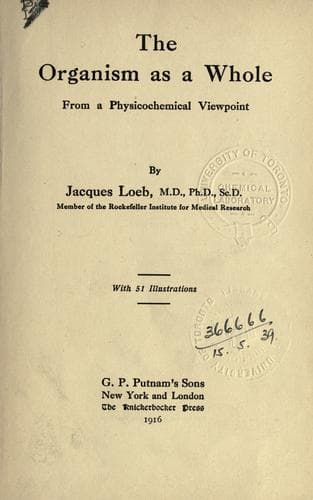
The Organism as a Whole, from a Physicochemical ViewpointLoeb, Jacques
Science
The Organism as a Whole, from a Physicochemical Viewpoint
Loeb, Jacques
Biology; Life (Biology); Mendel's law
Metchnikoff[305] has recently investigated the cause of “natural”
death in the butterfly of the silkworm. The butterfly in this species
lacks the organs necessary for taking up food, like the male rotifer
or the ephemeridæ and hence is already, by this fact, condemned to a
short life. Metchnikoff observed that these butterflies could live
twenty-three days, but the average duration of life was 15.6 for the
males and 16.6 days for the females; and that seventy-five per cent.
of them contained no parasitic fauna or flora in their intestine.
They lose considerably in weight during their lives, but the males
still contain the fat body at the time of death. None of the changes
accompanying “old age” in man are found in the tissues of these
butterflies before death. Metchnikoff is inclined to believe that the
animal is poisoned by some excretion retained in the body; namely,
the urine, and that this poison also causes the symptoms of weakness
which characterize the animal. He could prove the toxic character of
their urine on other animals. This combined with starvation could
sufficiently account for the short duration of life. The facts of the
case show that it is due to an imperfection in the construction of the
organism such as one would expect to find more or less in each animal
if one discards the idea of purposefulness and divine wisdom in nature.
Only a slight, perhaps an infinitesimal, fraction, of those species
which are theoretically possible and which at one time or another arise
can survive. Those which are durable show all transitions from the
grossest disharmonies to an apparent lack of such shortcomings.
[305] Metchnikoff, E., _Ann. d. l’Inst. Pasteur_, 1915, xxix., 477.
5. Minot had tried to prove that the death of metazoa is due to the
greater differentiation and specialization of their tissues. Admitting
the immortality of the unicellular organisms he argues that death is
the price metazoa pay for the higher differentiation of their cells.
This is of course purely metaphorical, but we may put it into a form in
which it is capable of discussion in physicochemical terms, by assuming
that death is a necessary stage in the development of a species. We
are inclined, however, to follow Metchnikoff and suspect some poison
accidentally or unavoidably formed in the body or some structural
shortcoming as the cause of “natural” death.
Public-domain text, read in full here on John Shaqi.
Reviews
Reviews
No reviews yet
Be the first to share your thoughts on this work.
Elsewhere in the archive
Join the Discussion
Join the discussion
Sign in to leave a comment or review.
Sign InorCreate an account