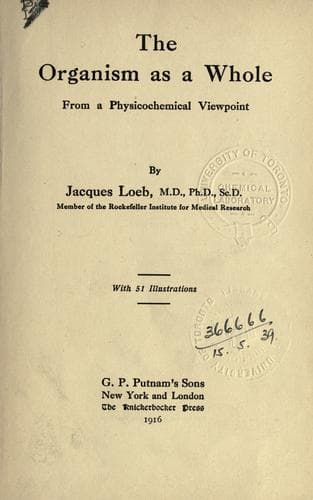
The Organism as a Whole, from a Physicochemical ViewpointLoeb, Jacques
Science
The Organism as a Whole, from a Physicochemical Viewpoint
Loeb, Jacques
Biology; Life (Biology); Mendel's law
2. It is practically impossible to transplant organs or tissues from
one species of higher animals to another, unless the two species
are very closely related; and even then the transplantation is
uncertain and the graft may either fall off again or be destroyed.
This specificity of tissues goes so far that surgeons prefer, when a
transplantation of skin in the human is intended, to use skin of the
patient or of close blood relations. The reason why the tissues of a
foreign species in warm-blooded animals cannot grow well on a given
host has been explained by the remarkable experiments of James B.
Murphy of the Rockefeller Institute.[32] Murphy discovered that it is
possible to transplant successfully any kind of foreign tissue upon
the early embryo of the chick. Even human tissue transplanted upon the
chick embryo will grow rapidly. This shows that at this early stage
the chick embryo does not yet react against foreign tissue. This lack
of reaction lasts until about the twenty-first day in the life of the
embryo; then the growth of the graft not only ceases but the graft
itself falls off or is destroyed. Murphy noticed that this critical
period coincides with the development of the spleen and of lymphatic
tissue in the chick and that a certain type of migrating cells, the
so-called lymphocytes, which develop in the lymphatic tissue, gather
at the edge of the graft in great numbers, and he suggested that these
lymphocytes (by a secretion of some substance?) rid the host of the
graft. He applied two tests both of which confirmed this idea. First he
showed that when small fragments of the spleen of an adult chicken are
transplanted into the embryo the latter loses its tolerance for foreign
grafts. The second proof is still more interesting. It was known that
by treatment with Roentgen rays the lymphocytes in an animal could be
destroyed. It was to be expected that an animal so treated would have
lost its specific resistance to foreign tissues. Murphy found that this
was actually the case. On fully grown rats in which the lymphocytes
had been destroyed by X-rays (as ascertained by blood counts) tissues
of foreign species grew perfectly well. These experiments have assumed
a great practical importance since they can also be applied to the
immunization of an animal against transplanted cancer of its own
species. Murphy found that by increasing the number of lymphocytes in
an animal (which can be accomplished by a mild treatment with X-rays)
the immunity against foreign grafts as well as against cancer from the
same species can be increased. It is quite possible that the apparent
immunity to a transplantation of cancer produced by Jensen, Leo Loeb,
and Ehrlich and Apolant through the previous transplantation of tissue
in such an animal was due to the fact that this previous tissue
transplantation led to an increase in the number of lymphocytes in the
animal. The medical side, however, lies outside of our discussion, and
Public-domain text, read in full here on John Shaqi.
Reviews
Reviews
No reviews yet
Be the first to share your thoughts on this work.
Join the Discussion
Join the discussion
Sign in to leave a comment or review.
Sign InorCreate an account