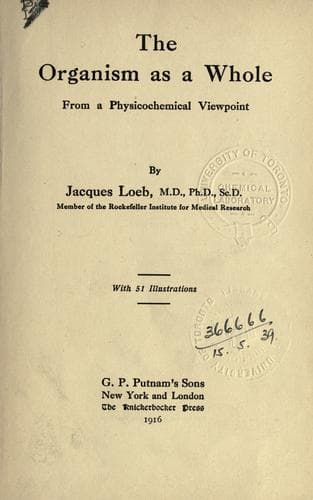
The Organism as a Whole, from a Physicochemical Viewpoint — John Shaqi
The Organism as a Whole, from a Physicochemical ViewpointLoeb, Jacques
Science
The Organism as a Whole, from a Physicochemical Viewpoint
Loeb, Jacques
Biology; Life (Biology); Mendel's law
[59] Loeb, J., and Bancroft, F. W., _Jour. Exper. Zoöl._, 1912, xii.,
381.
CHAPTER IV
SPECIFICITY IN FERTILIZATION
1. We have become acquainted with two characteristics of living
matter: the specificity due to the specific proteins characteristic
for each genus and possibly species and the synthesis of living matter
from the split products of their main constituents instead of from
a supersaturated solution of their own substance, as is the case in
crystals. We are about to discuss in this and the next chapter a third
characteristic, namely, the phenomenon of fertilization. While this
is not found in all organisms it is found in an overwhelming majority
and especially the higher organisms, and of all the mysteries of
animated nature that of fertilization and sex seems to be the most
captivating, to judge from the space it occupies in folklore, theology,
and “literature.” Bacteria, when furnished the proper nutritive medium,
will synthetize the specific material of their own body, will grow
and divide, and this process will be repeated indefinitely as long
as the food lasts and the temperature and other outside conditions
are normal. It is purely due to limitation of food that bacteria
or certain species of them do not cover the whole planet. But, as
every layman knows, the majority of organisms grow only to a certain
size, then die, and the propagation takes place through sex cells or
gametes: a female cell--the egg--containing a large bulk of protoplasm
(the future embryo) and reserve material; and the male cell which in
the case of the spermatozoön contains only nuclear material and no
cytoplasmic material except that contained in the tail which in some
and possibly many species does not enter the egg. The male element--the
spermatozoön--enters the female gamete--the egg--and this starts the
development. In the case of most animals the egg cannot develop unless
the spermatozoön enters. The question arises: How does the spermatozoön
activate the egg? And also how does it happen that the spermatozoön
enters the egg? We will first consider the latter question. These
problems can be answered best from experiments on forms in which the
egg and the sperm are fertilized in sea water. Many marine animals,
from fishes down to lower forms, shed their eggs and sperm into the sea
water where the fertilization of the egg takes place, outside the body
of the female.
Public-domain text, read in full here on John Shaqi.
Reviews
Reviews
No reviews yet
Be the first to share your thoughts on this work.
Join the Discussion
Join the discussion
Sign in to leave a comment or review.
Sign InorCreate an account