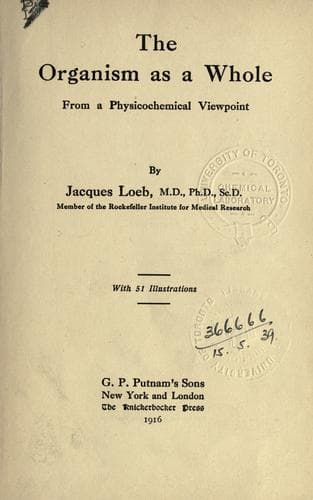
The Organism as a Whole, from a Physicochemical Viewpoint — John Shaqi
The Organism as a Whole, from a Physicochemical ViewpointLoeb, Jacques
Science
The Organism as a Whole, from a Physicochemical Viewpoint
Loeb, Jacques
Biology; Life (Biology); Mendel's law
By this method fifty per cent. or more of the eggs of _purpuratus_
could be fertilized with the sperm of the starfish _Asterias ochracea,
capitata_, Ophiurians, and Holothurians, while with the sperm of
another starfish, _Pycnopodia spuria_, only five per cent., and with
the sperm of _Asterina_ only one per cent. could be fertilized.[60]
Godlewski succeeded by the same method in fertilizing the eggs of a
Naples starfish with the sperm of a crinoid.[61] The writer did not
succeed in bringing about the fertilization of the egg of another sea
urchin in California, _Strongylocentrotus franciscanus_, with the sperm
of a starfish. Although these eggs formed a membrane in contact with
the sperm, the latter did not enter the egg; nor has the writer as
yet succeeded in causing the sperm of _Asterias_ to enter the egg of
_Arbacia_.
[60] Loeb, J., _Arch. f. d. ges. Physiol._, 1903, xcix., 323; 1904,
civ., 325; _Arch. f. Entwcklngsmech._, 1910, xxx., II., 44; 1914, xl.,
310; _Science_, 1914, xl., 316.
[61] Godlewski, E., _Arch. f. Entwcklngsmech._, 1906, xx., 579.
Kupelwieser[62] observed that the spermatozoön of molluscs may
occasionally enter into the egg of _S. purpuratus_ in normal sea
water and later, at Naples, he observed the same for the sperm of
annelids. In these cases no development took place. In teleost fishes
the spermatozoön can enter the eggs of widely different species but
with rare exceptions all the embryos will die in an early stage of
development.[63]
[62] Kupelwieser, H., _Arch. f. Entwcklngsmech._, 1909, xxvii., 434;
_Arch. f. Zellforsch._, 1912, viii., 352.
[63] See Chapter II.
2. The fact that an increase in the alkalinity or in the concentration
of calcium allowed foreign sperm to enter the egg of the sea urchin,
suggested the idea that a diminution of alkalinity or calcium in the
sea water might block the entrance of the sperm of sea urchin into
eggs of their own species. This was found to be correct; when we put
eggs and sperm of the same species of sea urchin into solutions whose
concentration of Ca or of OH is too small, the sperm, although it may
be intensely active, cannot enter the egg.
Public-domain text, read in full here on John Shaqi.
Reviews
Reviews
No reviews yet
Be the first to share your thoughts on this work.
Join the Discussion
Join the discussion
Sign in to leave a comment or review.
Sign InorCreate an account