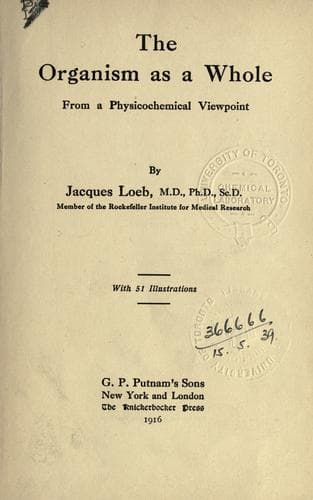
The Organism as a Whole, from a Physicochemical ViewpointLoeb, Jacques
Science
The Organism as a Whole, from a Physicochemical Viewpoint
Loeb, Jacques
Biology; Life (Biology); Mendel's law
The writer suggests the following explanation of the phenomenon. The
egg sea water contains a substance which forms a precipitate with a
substance on the surface of the spermatozoön whereby the latter becomes
slightly sticky. This precipitate is slowly soluble in sea water and
the more rapidly the more alkaline (within certain limits). Only when
the spermatozoa run against each other with a certain impact will
they stick together, as Lillie suggested. Lillie assumes that this
agglutinating substance contained in egg sea water is required to
bring about fertilization and he therefore calls it “fertilizin.”[72]
But this assumption seems to go beyond the facts inasmuch as the
existence of such an agglutinating substance can only be proved in a
few species of animals (sea urchins and annelids); and as, moreover,
sea-urchin sperm can fertilize eggs which will not cause the sperm to
agglutinate, _e. g._, the egg of _franciscanus_ can be fertilized by
sperm of _purpuratus_, although the egg sea water of _franciscanus_
causes no agglutination of the sperm of _purpuratus_. When the jelly
surrounding the egg of the Californian sea urchin _S. purpuratus_ is
dissolved with acid and the eggs are washed, the eggs will not cause
any more sperm agglutination; and yet one hundred per cent. of such
eggs can be fertilized by sperm.[73]
[72] Lillie, F. R., _loc. cit._
[73] Loeb, J., _Jour. Exper. Zoöl_., 1914, xvii., 123; _Am.
Naturalist_, 1915, xlix., 257.
5. It is well known that if an egg is once fertilized it becomes
impermeable for other spermatozoa. This cannot well be due to the fact
that the egg develops; for the writer found some time ago that eggs of
_Strongylocentrotus purpuratus_ which are induced to develop by means
of artificial parthenogenesis can be fertilized by sperm. The following
observation leaves no doubts in this respect. When the unfertilized
eggs of _purpuratus_ are put for two hours into hypertonic sea water
(50 c.c. of sea water+8 c.c. 2-1/2 m NaCl) and then transferred into
sea water it occasionally happens that a certain percentage of the eggs
will begin to divide into 2, 4, 8 or more cells, without developing
any further. When to such eggs after they have remained in the resting
stage for a number of hours or a day, sperm is added, some or all
of the blastomeres form a fertilization membrane and now begin to
develop into larvæ; and if the spermatozoön gets into a blastomere of
the 2- or 4-cell stage normal plutei will result. When the sperm is
added while the eggs are in active parthenogenetic cell division the
individual blastomeres into which a spermatozoön enters will also form
a fertilization membrane, but such blastomeres perish very rapidly. It
is not yet possible to state why it should make such a difference for
the possibility of development whether the spermatozoön enters into
a blastomere when at rest or when it is in active nuclear division,
although the idea presents itself that in the latter case an abnormal
Public-domain text, read in full here on John Shaqi.
Reviews
Reviews
No reviews yet
Be the first to share your thoughts on this work.
Join the Discussion
Join the discussion
Sign in to leave a comment or review.
Sign InorCreate an account