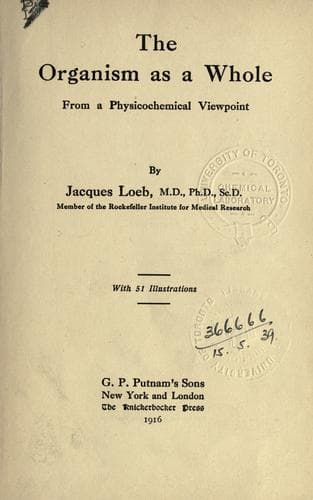
The Organism as a Whole, from a Physicochemical ViewpointLoeb, Jacques
Science
The Organism as a Whole, from a Physicochemical Viewpoint
Loeb, Jacques
Biology; Life (Biology); Mendel's law
Lillie does not assume that the “fertilizin” causes an agglutination
between egg and spermatozoön--we should assent to such an
assumption--but that the “fertilizin” acts like an “amboceptor” between
egg and spermatozoön, the latter being the complement, the former the
antigen. The pathologist would probably object to this interpretation
since no “amboceptor” is needed for agglutination. The writer has had
some doubts concerning the value of Ehrlich’s side-chain theory which,
besides, can only be applied in a metaphorical sense to the mechanism
of the entrance of the spermatozoön into the egg.[76]
[76] Loeb, J., _Am. Naturalist_, 1915, xlix., 257.
The writer may be permitted to illustrate by a special case his reason
for declining to accept Ehrlich’s side-chain theory. Ehrlich and Sachs
found that if to a given mass of toxin small quantities of antitoxin
are added successively the first fraction added neutralized more
than the later fractions; and on the basis of this reasoning Ehrlich
concluded that ten different toxins were contained in the diphtheria
toxin. Arrhenius showed that the same phenomenon can be obtained when
a weak base like NH₄OH is neutralized by a weak acid (_e. g._, boric
acid); hence we should assume that NH₄OH consists of ten different
forms of ammonia. Both cases, the saturation of toxin with antitoxin
and ammonia with boric acid are equilibrium phenomena. (Arrhenius, S.,
_Quantitative Laws in Biological Chemistry_, London, 1915.)
6. The reason that an egg once fertilized with sperm cannot be
fertilized again may be found in a group of facts which we will now
discuss, namely, the self-sterility of many hermaphrodites. The fact
that hermaphrodites are often self-sterile, while their eggs can be
fertilized with sperm from a different individual of the same species
has played a great rôle in the theories of evolution. We are here only
concerned with the mechanism which determines the block to the entrance
of a spermatozoön into an egg of the same hermaphroditic individual.
Public-domain text, read in full here on John Shaqi.
Reviews
Reviews
No reviews yet
Be the first to share your thoughts on this work.
Join the Discussion
Join the discussion
Sign in to leave a comment or review.
Sign InorCreate an account