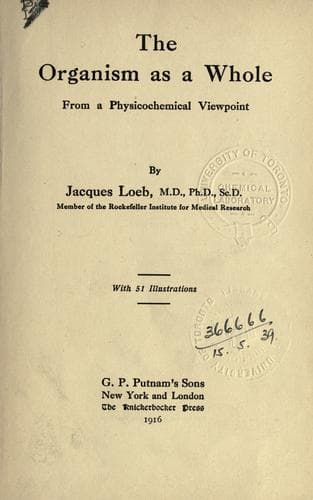
The Organism as a Whole, from a Physicochemical ViewpointLoeb, Jacques
Science
The Organism as a Whole, from a Physicochemical Viewpoint
Loeb, Jacques
Biology; Life (Biology); Mendel's law
It may be of some interest to point out that we do not need to make any
definite assumption concerning the mechanism of evolution and that we
may yet be able to account for the fact that the surviving organisms
are to all appearances harmonious. The writer pointed out that of all
the 100,000,000 conceivable crosses of teleost fish (many of which
are possible) not many more than 10,000, _i. e._, about one-hundredth
of one per cent., are able to live and propagate. Those that live and
develop are free from the grosser type of disharmonies, the rest are
doomed on account of a gross lack of harmony of the parts. These latter
we never see and this gives us the erroneous conception that harmony
or “design” is a general character of living matter. If anybody wishes
to call the non-viability of 99-99/100 per cent. of possible teleosts
a process of weeding out by “natural selection” we shall raise no
objection, but only wish to point out that our way of explaining the
lack of design in living nature would be valid even if there were no
theory of evolution or if there had never been any evolution.
3. v. Uexküll is perfectly right in connecting the problem of design
in an organism with Mendelian heredity. The work on Mendelian heredity
has shown that an extremely large number of independently transmissible
Mendelian factors help to shape the individual. It is not yet proven
that the organism is nothing but a mosaic of Mendelian factors, but no
writer can be blamed for considering such a possibility. If we assume
that the organism is nothing but a mosaic of Mendelian characters it
is difficult indeed to understand how they can force each other into a
harmonious whole[6]; even if we make ample allowance for the law of
chance and the corresponding wastefulness in the world of the living.
But it is doubtful whether this idea of the rôle of Mendelian factors
is correct. The facts of experimental embryology strongly indicate the
possibility that the cytoplasm of the egg is the future embryo (in the
rough) and that the Mendelian factors only impress the individual (and
variety) characters upon this rough block. This idea is supported by
the fact that the first development--in the sea urchin to the gastrula
stage inclusive--is independent of the nucleus, which is the bearer of
the Mendelian factors. Not before the skeleton or mesenchyme is formed
in the sea urchin egg is the influence of the nucleus noticeable. This
has been shown in the experiments of Boveri in which an enucleated
fragment of an egg was fertilized with a spermatozoön of a foreign
species. If this is generally true, it is conceivable that the generic
and possibly also the species characters of organisms are determined by
the cytoplasm of the egg and not by the Mendelian factors.
Public-domain text, read in full here on John Shaqi.
Reviews
Reviews
No reviews yet
Be the first to share your thoughts on this work.
Join the Discussion
Join the discussion
Sign in to leave a comment or review.
Sign InorCreate an account