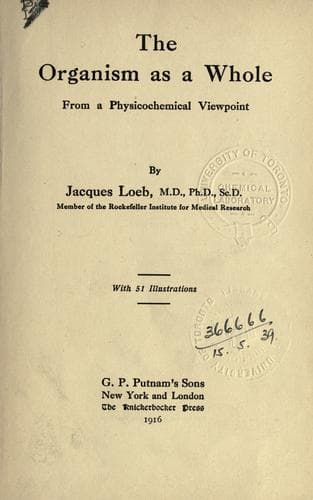
The Organism as a Whole, from a Physicochemical ViewpointLoeb, Jacques
Science
The Organism as a Whole, from a Physicochemical Viewpoint
Loeb, Jacques
Biology; Life (Biology); Mendel's law
The objection may be raised that in accepting Boveri’s facts and
interpretation we pushed the miracle only one step farther and that we
now have to explain the origin of the structure in the unfertilized
egg. This Boveri has done by showing that the egg grows from the wall
of the ovary and that that part of the egg which is connected with the
wall of the ovary gives rise to the ectoderm layer, while the opposite
part gives rise to the mesenchyme and the intestine. This shows a
connection between the orientation of the egg in the wall of the ovary
and its stratification. While this does not solve the problem of
stratification in the egg it gives the clue to its solution.
The ultimate origin of stratification probably goes back to the fact
of the presence of watery and water-immiscible substances, such as
fats. The experiments by Beutner and the writer have shown that the
electromotive forces which are observed in living tissues originate
at the boundaries between a watery and a water-immiscible phase, like
oleic acid or lecithin.[125] In his earlier writings[126] the writer
had thought that the colloids had special significance and this idea
seems to prevail today; but the actual observations have shown that the
phase boundary fat-water is of greater importance. Needless to say the
fats if not present in the cell from the beginning can be formed in the
metabolism.
[125] Loeb, J., and Beutner, R., _Biochem. Ztschr._, 1912, xli., 1;
xliv., 303; 1913, li., 288; li., 300; 1914, lix., 195.
[126] Loeb, J., _The Dynamics of Living Matter_. New York, 1906.
Introductory Remarks.
4. All the “regulation” in the egg is of a purely physicochemical
character; it consists essentially of a flow of material. If this idea
is correct, the apparent power of “regulation” of the blastomeres
should differ according to the degree of fluidity and the possibility
of different layers separating, and this assumption is apparently
supported by facts. The first plane of segmentation of the egg is
usually the plane of symmetry of the later organism and where the
degree of fluidity is less than in the sea-urchin egg, a separation of
the two first blastomeres should easily result in the formation of two
half-embryos instead of two whole embryos.
Public-domain text, read in full here on John Shaqi.
Reviews
Reviews
No reviews yet
Be the first to share your thoughts on this work.
Elsewhere in the archive
Join the Discussion
Join the discussion
Sign in to leave a comment or review.
Sign InorCreate an account