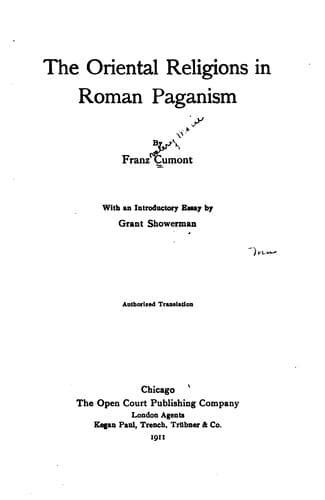
The Oriental Religions in Roman PaganismCumont, Franz
Religion
The Oriental Religions in Roman Paganism
Cumont, Franz
Paganism -- Rome; Religions; Rome -- Religion
As a matter of fact, his power was infinite. The primary postulate of the
Chaldean astrology was that all phenomena and events of this world were
necessarily determined by sidereal influence. The changes of nature, as
well as the dispositions of men, were controlled according to fate, by the
divine energies that resided in the heavens. In other words, the gods were
almighty; they were the masters of destiny that governed the universe
absolutely. The notion of their {129} omnipotence resulted from the
development of the ancient autocracy with which the Baals were credited. As
we have stated, they were conceived after the image of an Asiatic monarch,
and the religious terminology was evidently intended to display the
humility of their priests toward them. In Syria we find nothing analogous
to what existed in Egypt, where the priest thought he could compel the gods
to act, and even dared to threaten them.[74] The distance separating the
human and the divine always was much greater with the Semitic tribes, and
all that astrology did was to emphasize the distance more strongly by
giving it a doctrinal foundation and a scientific appearance. In the Latin
world the Asiatic religions propagated the conception of the absolute and
illimitable sovereignty of God over the earth. Apuleius calls the Syrian
goddess _omnipotens et omniparens_, "mistress and mother of all
things."[75]
The observation of the starry skies, moreover, had led the Chaldeans to the
notion of a divine eternity. The constancy of the sidereal revolutions
inspired the conclusion as to their perpetuity. The stars follow their ever
uncompleted courses unceasingly; as soon as the end of their journey is
reached, they resume without stopping the road already covered, and the
cycles of years in which their movements take place extend from the
indefinite past into the indefinite future.[76] Thus a clergy of
astronomers necessarily conceived Baal, "Lord of the heavens," as the
"Master of eternity" or "He whose name is praised through all
eternity"[77]--titles which constantly recur in Semitic inscriptions. The
divine stars did not die, like Osiris or Attis; whenever they seemed to
weaken, they were {130} born to a new life and always remained invincible
(_invicti_).
Public-domain text, read in full here on John Shaqi.
Reviews
Reviews
No reviews yet
Be the first to share your thoughts on this work.
Elsewhere in the archive
Join the Discussion
Join the discussion
Sign in to leave a comment or review.
Sign InorCreate an account