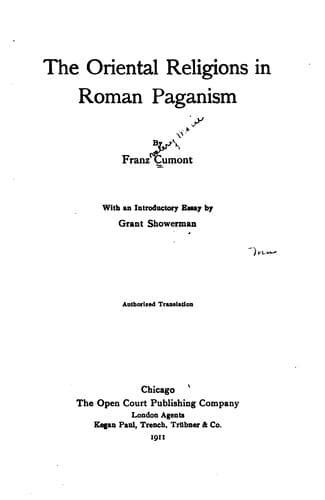
The Oriental Religions in Roman PaganismCumont, Franz
Religion
The Oriental Religions in Roman Paganism
Cumont, Franz
Paganism -- Rome; Religions; Rome -- Religion
Together with the mysteries of the Syrian Baals, this theological notion
penetrated into Occidental paganism.[78] Whenever an inscription to a _deus
aeternus_ is found in the Latin provinces it refers to a Syrian sidereal
god, and it is a remarkable fact that this epithet did not enter the ritual
before the second century, at the time the worship of the god Heaven
(_Caelus_)[79] was propagated. That the philosophers had long before placed
the first cause beyond the limits of time was of no consequence, for their
theories had not penetrated into the popular consciousness nor modified the
traditional formulary of the liturgies. To the people the divinities were
beings more beautiful, more vigorous, and more powerful than man, but born
like him, and exempt only from old age and death, the immortals of old
Homer. The Syrian priests diffused the idea of a god without beginning and
without end through the Roman world, and thus contributed, along lines
parallel with the Jewish proselytism, to lend the authority of dogma to
what had previously been only a metaphysical theory.
The Baals were universal as well as eternal, and their power became
limitless in regard to space as it had been in regard to time. These two
principles were correlative. The title of "_mar'olam_" which the Baals bore
occasionally may be translated by "Lord of the universe," or by "Lord of
eternity," and efforts certainly have been made to claim the twofold
quality for them.[80] Peopled with divine constellations and traversed by
planets assimilated to the inhabitants of Olympus, the heavens determined
the destinies of the {131} entire human race by their movements, and the
whole earth was subject to the changes produced by their revolutions.[81]
Consequently the old _Ba'al [vs]amin_ was necessarily transformed into a
universal power. Of course, even under the Caesars there existed in Syria
traces of a period when the local god was the fetich of a clan and could be
worshiped by the members of that clan only, a period when strangers were
admitted to his altars only after a ceremony of initiation, as brothers, or
at least as guests and clients.[82] But from the period when our knowledge
of the history of the great divinities of Heliopolis or Hierapolis begins,
these divinities were regarded as common to all Syrians, and crowds of
pilgrims came from distant countries to obtain grace in the holy cities. As
protectors of the entire human race the Baals gained proselytes in the
Occident, and their temples witnessed gatherings of devotees of every race
and nationality. In this respect the Baals were distinctly different from
Jehovah.
Public-domain text, read in full here on John Shaqi.
Reviews
Reviews
No reviews yet
Be the first to share your thoughts on this work.
Elsewhere in the archive
Join the Discussion
Join the discussion
Sign in to leave a comment or review.
Sign InorCreate an account