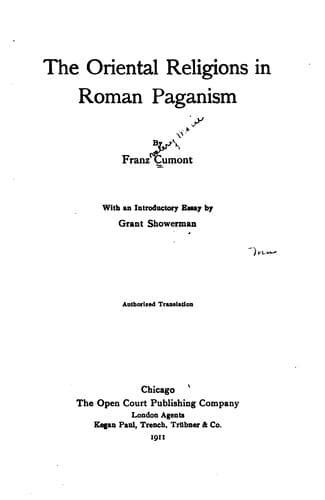
The Oriental Religions in Roman PaganismCumont, Franz
Religion
The Oriental Religions in Roman Paganism
Cumont, Franz
Paganism -- Rome; Religions; Rome -- Religion
Under the empire, while the Semitic Baals and Mithra were triumphing,
astrology manifested its power everywhere. During that period everybody
bowed to it. The Caesars became its fervent devotees, frequently at the
expense of the ancient cults. Tiberius neglected the gods because he
believed only in fatalism,[6] and Otho, blindly confiding in the Oriental
seer, marched against Vitellius in spite of the baneful presages that
affrighted his official clergy.[7] The most earnest scholars, Ptolemy under
the Antonines for instance, expounded the principles of that
pseudo-science, and the very best minds received them. In fact, scarcely
anybody made a distinction between astronomy and its illegitimate sister.
Literature took up this new and difficult subject, and, as early as the
time of Augustus or Tiberius, Manilius, inspired by the sidereal fatalism,
endeavored to make poetry of that dry "mathematics," as Lucretius, his
forerunner, had done with the Epicurean atomism. Even art looked there for
inspiration and depicted the stellar deities. At Rome and in the provinces
architects erected sumptuous _septizonia_ in the likeness of {165} the
seven spheres in which the planets that rule our destinies move.[8] This
Asiatic divination was first aristocratic[9]--because the obtaining of an
exact horoscope was a complicated matter, and consultations were
expensive--but it promptly became popular, especially in the urban centers
where Oriental slaves gathered in large numbers. The learned
genethlialogers of the observatories had unlicensed colleagues, who told
fortunes at street-crossings or in barnyards. Even common epitaphs, which
Rossi styles "the scum of inscriptions," have retained traces of that
belief. The custom arose of stating in epitaphs the exact length of a life
to the very hour, for the moment of birth determined that of death:
_Nascentes morimur, finisque ab origine pendet._[10]
Soon neither important nor small matters were undertaken without consulting
the astrologer. His previsions were sought not only in regard to great
public events like the conduct of a war, the founding of a city, or the
accession of a ruler, not only in case of a marriage, a journey, or a
change of domicile; but the most trifling acts of every-day life were
gravely submitted to his sagacity. People would no longer take a bath, go
to the barber, change their clothes or manicure their fingernails, without
first awaiting the propitious moment.[11] The collections of "initiatives"
([Greek: katarchai]) that have come to us contain questions that make us
smile: Will a son who is about to be born have a big nose? Will a girl just
coming into this world have gallant adventures?[12] And certain precepts
sound almost like burlesques: he who gets his hair cut while {166} the moon
is in her increase will become bald--evidently by analogy.[13]
Public-domain text, read in full here on John Shaqi.
Reviews
Reviews
No reviews yet
Be the first to share your thoughts on this work.
Elsewhere in the archive
Join the Discussion
Join the discussion
Sign in to leave a comment or review.
Sign InorCreate an account