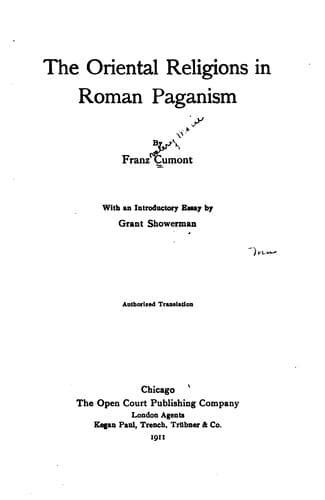
The Oriental Religions in Roman PaganismCumont, Franz
Religion
The Oriental Religions in Roman Paganism
Cumont, Franz
Paganism -- Rome; Religions; Rome -- Religion
The entire existence of states and individuals, down to the slightest
incidents, was thought to depend on the stars. The absolute control they
were supposed to exercise over everybody's daily condition, even modified
the language in every-day use and left traces in almost all idioms derived
from the Latin. If we speak of a martial, or a jovial character, or a
lunatic, we are unconsciously admitting the existence, in these heavenly
bodies (Mars, Jupiter, Luna) of their ancient qualities.
It must be acknowledged, however, that the Grecian spirit tried to combat
the folly that was taking hold of the world, and from the time of its
propagation astrology found opponents among the philosophers. The most
subtle of these adversaries was the probabilist Carneades, in the second
century before our era. The topical arguments which he advanced, were taken
up, reproduced, and developed in a thousand ways by later polemicists. For
instance, Were all the men that perish together in a battle, born at the
same moment, because they had the same fate? Or, on the other hand, do we
not observe that twins, born at the same time, have the most unlike
characters and the most different fortunes?
But dialectics are an accomplishment in which the Greeks ever excelled, and
the defenders of astrology found a reply to every objection. They
endeavored especially to establish firmly the truths of observation, upon
which rested the entire learned structure of their art: the influence of
the stars over the phenomena of nature and the characters of individuals.
Can it be {167} denied, they said, that the sun causes vegetation to appear
and to perish, and that it puts animals _en rut_ or plunges them into
lethargic sleep? Does not the movement of the tide depend on the course of
the moon? Is not the rising of certain constellations accompanied every
year by storms? And are not the physical and moral qualities of the
different races manifestly determined by the climate in which they live?
The action of the sky on the earth is undeniable, and, the sidereal
influences once admitted, all previsions based on them are legitimate. As
soon as the first principle is admitted, all corollaries are logically
derived from it.
Public-domain text, read in full here on John Shaqi.
Reviews
Reviews
No reviews yet
Be the first to share your thoughts on this work.
Elsewhere in the archive
Join the Discussion
Join the discussion
Sign in to leave a comment or review.
Sign InorCreate an account