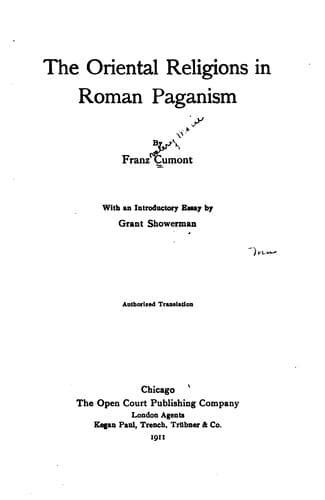
The Oriental Religions in Roman PaganismCumont, Franz
Religion
The Oriental Religions in Roman Paganism
Cumont, Franz
Paganism -- Rome; Religions; Rome -- Religion
This way of reasoning was universally considered irrefutable. Before the
advent of Christianity, which especially opposed it because of its
idolatrous character, astrology had scarcely any adversaries except those
who denied the possibility of science altogether, namely, the
neo-Academicians, who held that man could not attain certainty, and such
radical sceptics as Sextus Empiricus. Upheld by the Stoics, however, who
with very few exceptions were in favor of astrology, it can be maintained
that it emerged triumphant from the first assaults directed against it. The
only result of the objections raised to it was to modify some of its
theories. Later, the general weakening of the spirit of criticism assured
astrology an almost uncontested domination. Its adversaries did not renew
their polemics; they limited themselves to the repetition of arguments that
had been opposed, if not refuted, a hundred times, and consequently seemed
worn out. At the court of the Severi any one who should have denied the
influence of the planets upon the events of this world {168} would have
been considered more preposterous than he who would admit it to-day.
But, you will say, if the theorists did not succeed in proving the
doctrinal falsity of astrology, experience should have shown its
worthlessness. Errors must have occurred frequently and must have been
followed by cruel disillusionment. Having lost a child at the age of four
for whom a brilliant future had been predicted, the parents stigmatized in
the epitaph the "lying mathematician whose great renown deluded them."[14]
Nobody thought of denying the possibility of such errors. Manuscripts have
been preserved, wherein the makers of horoscopes themselves candidly and
learnedly explain how they were mistaken in such and such a case, because
they had not taken into account some one of the data of the problem.[15]
Manilius, in spite of his unlimited confidence in the power of reason,
hesitated at the complexity of an immense task that seemed to exceed the
capacity of human intelligence,[16] and in the second century, Vettius
Valens bitterly denounced the contemptible bunglers who claimed to be
prophets, without having had the long training necessary, and who thereby
cast odium and ridicule upon astrology, in the name of which they pretended
to operate.[17] It must be remembered that astrology, like medicine, was
not only a science ([Greek: episteme]), but also an art ([Greek: techne]).
This comparison, which sounds irreverent to-day, was a flattering one in
the eyes of the ancients.[18] To observe the sky was as delicate a task as
to observe the human body; to cast the horoscope of a newly born child,
just as perilous as to make a diagnosis, and to interpret the cosmic
symptoms just as hard as to {169} interpret those of our organism. In both
instances the elements were complex and the chances of error infinite. All
the examples of patients dying in spite of the physician, or on account of
Public-domain text, read in full here on John Shaqi.
Reviews
Reviews
No reviews yet
Be the first to share your thoughts on this work.
Elsewhere in the archive
Join the Discussion
Join the discussion
Sign in to leave a comment or review.
Sign InorCreate an account