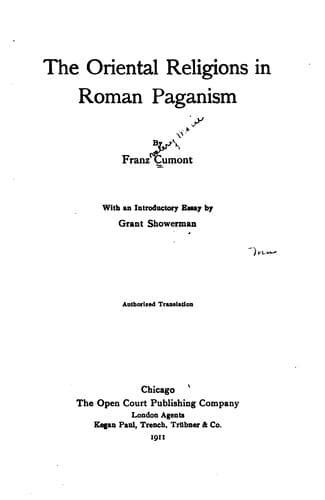
The Oriental Religions in Roman PaganismCumont, Franz
Religion
The Oriental Religions in Roman Paganism
Cumont, Franz
Paganism -- Rome; Religions; Rome -- Religion
The Greek works and treatises on astrology that have come down to us reveal
this essential feature only very imperfectly. The Byzantines stripped this
pseudo-science, always regarded suspiciously by the church, of everything
that savored of paganism. Their process of purification can, in some
instances, be traced from manuscript to manuscript.[20] If they retained
the name of some god or hero of mythology, the only way they dared to write
it was by cryptography. They have especially preserved purely didactic
treatises, the most perfect type of which is Ptolemy's Tetrabiblos which
has been constantly quoted and commented upon; and they have reproduced
almost exclusively expurgated texts, in which the principles of various
doctrines are drily summarized. During the classic age works of a different
character were commonly read. Many "Chaldeans" interspersed their
cosmological calculations and theories with moral considerations and
mystical speculations. In the first part of a work that he names "Vision,"
([Greek: Horasis]) Critodemus, in prophetic language, represents the truths
he reveals {171} as a secure harbor of refuge from the storms of this
world, and he promises his readers to raise them to the rank of
immortals.[21] Vettius Valens, a contemporary of Marcus Aurelius, implored
them in solemn terms, not to divulge to the ignorant and impious the arcana
he was about to acquaint them with.[22] The astrologers liked to assume the
appearance of incorruptible and holy priests and to consider their calling
a sacerdotal one.[23] In fact, the two ministries sometimes combined: A
dignitary of the Mithraic clergy called himself _studiosus astrologiae_[24]
in his epitaph, and a member of a prominent family of Phrygian prelates
celebrated in verse the science of divination which enabled him to issue a
number of infallible predictions.[25]
The sacred character of astrology revealed itself in some passages that
escaped the orthodox censure and in the tone some of its followers assumed,
but we must go further and show that astrology was religious in its
principles as well as in its conclusions, the debt it owed to mathematics
and observation notwithstanding.
Public-domain text, read in full here on John Shaqi.
Reviews
Reviews
No reviews yet
Be the first to share your thoughts on this work.
Elsewhere in the archive
Join the Discussion
Join the discussion
Sign in to leave a comment or review.
Sign InorCreate an account