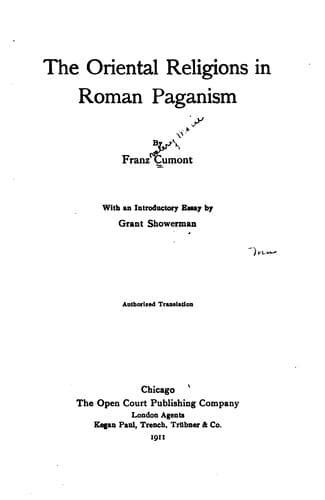
The Oriental Religions in Roman PaganismCumont, Franz
Religion
The Oriental Religions in Roman Paganism
Cumont, Franz
Paganism -- Rome; Religions; Rome -- Religion
The fundamental dogma of astrology, as conceived by the Greeks, was that of
universal solidarity. The world is a vast organism, all the parts of which
are connected through an unceasing exchange of molecules of effluvia. The
stars, inexhaustible generators of energy, constantly act upon the earth
and man--upon man, the epitome of all nature, a "microcosm" whose every
element corresponds to some part of the starry sky. This was, in a few
words, the theory formulated by the Stoic disciples of the Chaldeans;[26]
but if we divest it of all the philosophic garments with which it has been
adorned, what do we find? The idea of {172} sympathy, a belief as old as
human society! The savage peoples also established mysterious relations
between all bodies and all the beings that inhabit the earth and the
heavens, and which to them were animated with a life of their own endowed
with latent power, but we shall speak of this later on, when taking up the
subject of magic. Even before the propagation of the Oriental religions,
popular superstition in Italy and Greece attributed a number of odd actions
to the sun, the moon, and the constellations as well.[27]
The Chaldaei, however, claimed a predominant power for the stars. In fact,
they were regarded as gods _par excellence_ by the religion of the ancient
Chaldeans in its beginnings. The sidereal religion of Babylon concentrated
deity, one might say, in the luminous moving bodies at the expense of other
natural objects, such as stones, plants, animals, which the primitive
Semitic faith considered equally divine. The stars always retained this
character, even at Rome. They were not, as to us, infinitely distant bodies
moving in space according to the inflexible laws of mechanics, and whose
chemical composition may be determined. To the Latins as to the Orientals,
they were propitious or baleful deities, whose ever-changing relations
determined the events of this world.
Public-domain text, read in full here on John Shaqi.
Reviews
Reviews
No reviews yet
Be the first to share your thoughts on this work.
Elsewhere in the archive
Join the Discussion
Join the discussion
Sign in to leave a comment or review.
Sign InorCreate an account