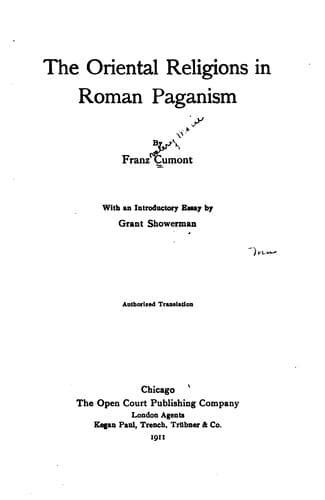
The Oriental Religions in Roman PaganismCumont, Franz
Religion
The Oriental Religions in Roman Paganism
Cumont, Franz
Paganism -- Rome; Religions; Rome -- Religion
The traditional outlines that we reproduce on our celestial maps are the
fossil remains of a luxuriant mythological vegetation, and besides our
classic sphere the ancients knew another, the "barbarian" sphere, peopled
with a world of fantastic persons and animals. These sidereal monsters, to
whom powerful qualities were ascribed, were likewise the remnants of a
multitude of forgotten beliefs. Zoolatry was abandoned in the temples, but
people continued to regard as divine the lion, the bull, the bear, and the
fishes, which the Oriental imagination had seen in the starry vault. Old
totems of the Semitic tribes or of the Egyptian divisions lived again,
transformed into constellations. Heterogeneous elements, taken from all the
religions of the Orient, were combined in the uranography of the ancients,
and in the power ascribed to the phantoms that it evoked, vibrates in the
indistinct echo of ancient devotions that are often completely unknown to
us.[30]
Astrology, then, was religious in its origin and in its principles. It was
religious also in its close relation to the Oriental religions, especially
those of the Syrian Baals and of Mithra; finally, it was religious in the
effects that it produced. I do not mean the effects expected from a
constellation in any particular instance: as for example the power to evoke
the gods that were subject to their domination.[31] But I have in mind the
general influence those doctrines exercised upon Roman paganism.
When the Olympian gods were incorporated among the stars, when Saturn and
Jupiter became planets and {175} the celestial virgin a sign of the zodiac,
they assumed a character very different from the one they had originally
possessed. It has been shown[32] how, in Syria, the idea of an infinite
repetition of cycles of years according to which the celestial revolutions
took place, led to the conception of divine eternity, how the theory of a
fatal domination of the stars over the earth brought about that of the
omnipotence of the "lord of the heavens," and how the introduction of a
universal religion was the necessary result of the belief that the stars
exerted an influence upon the peoples of every climate. The logic of all
these consequences of the principles of astrology was plain to the Latin as
well as to the Semitic races, and caused a rapid transformation of the
ancient idolatry. As in Syria, the sun, which the astrologers called the
leader of the planetary choir, "who is established as king and leader of
the whole world,"[33] necessarily became the highest power of the Roman
pantheon.
Public-domain text, read in full here on John Shaqi.
Reviews
Reviews
No reviews yet
Be the first to share your thoughts on this work.
Elsewhere in the archive
Join the Discussion
Join the discussion
Sign in to leave a comment or review.
Sign InorCreate an account