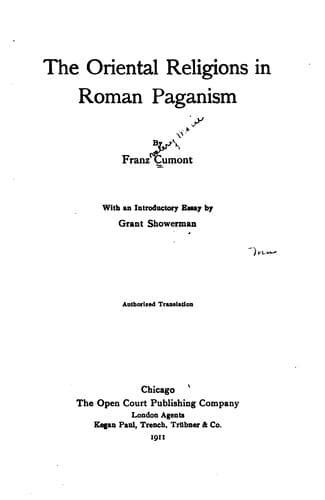
The Oriental Religions in Roman PaganismCumont, Franz
Religion
The Oriental Religions in Roman Paganism
Cumont, Franz
Paganism -- Rome; Religions; Rome -- Religion
The particular importance attributed to magic by the Mazdeans is a
necessary consequence of their dualist system, which has been treated by us
before.[74] Ormuzd, residing in the heavens of light, is opposed by his
irreconcilable adversary, Ahriman, ruler of the underworld. The one stands
for light, truth, and goodness, the other for darkness, falsehood, and
perversity. The one commands the kind spirits which protect the pious
believer, the other is master over demons whose malice causes all the evils
that afflict humanity. These opposite principles fight for the domination
of the earth, and each creates favorable or noxious animals and plants.
Everything on earth is either heavenly or infernal. Ahriman and his demons,
who surround man to tempt or hurt him,[75] are evil gods and entirely
different from those of which Ormuzd's host consists. The magician
sacrifices to them, either to avert evils they threaten, or to direct their
ire against enemies of true belief, and the impure spirits rejoice in
bloody immolations and delight in the fumes of flesh burning on the
altars.[76] Terrible acts and words attended all immolations. Plutarch[77]
mentions an example of the dark sacrifices of the Mazdeans. "In a mortar,"
he says, "they pound a certain herb called wild garlic, at the same time
invoking Hades (Ahriman), and the powers of darkness, then stirring this
herb in the blood of a slaughtered wolf, they take it away and drop it on a
spot never reached by the rays of the sun." A necromantic performance
indeed. {191}
Public-domain text, read in full here on John Shaqi.
Reviews
Reviews
No reviews yet
Be the first to share your thoughts on this work.
Elsewhere in the archive
Join the Discussion
Join the discussion
Sign in to leave a comment or review.
Sign InorCreate an account