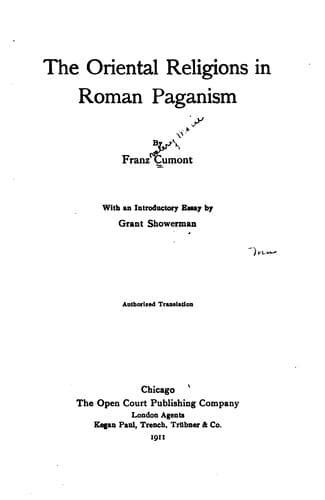
The Oriental Religions in Roman PaganismCumont, Franz
Religion
The Oriental Religions in Roman Paganism
Cumont, Franz
Paganism -- Rome; Religions; Rome -- Religion
Thus the ancient traditions of magic continued to live in the Christian
Orient after the fall of paganism. They even outlived the domination of the
church. The rigorous principles of its monotheism notwithstanding, Islam
became infected with those Persian superstitions. In the Occident the evil
art resisted persecution and anathemas with the same obstinacy as in the
Orient. It remained alive in Rome all through the fifth century,[82] and
when scientific astrology in Europe went down with science itself, the old
Mazdean dualism continued to manifest itself, during the entire Middle Ages
in the ceremonies of the black mass and the worshiping of Satan, until the
dawn of the modern era.
* * * * *
Twin sisters, born of the superstitions of the learned Orient, magic and
astrology always remained the hybrid daughters of sacerdotal culture. Their
existence {194} was governed by two contrary principles, reason and faith,
and they never ceased to fluctuate between these two poles of thought. Both
were inspired by a belief in universal sympathy, according to which occult
and powerful relations exist between human beings and dead objects, all
possessing a mysterious life. The doctrine of sidereal influences, combined
with a knowledge of the immutability of the celestial revolutions, caused
astrology to formulate the first theory of absolute fatalism, whose decrees
might be known beforehand. But, besides this rigorous determinism, it
retained its childhood faith in the divine stars, whose favor could be
secured and malignity avoided through worship. In astrology the
experimental method was reduced to the completing of prognostics based on
the supposed character of the stellar gods.
Magic also remained half empirical and half religious. Like our physics, it
was based on observation, it proclaimed the constancy of the laws of
nature, and sought to conquer the latent energies of the material world in
order to bring them under the dominion of man's will. But at the same time
it recognized, in the powers that it claimed to conquer, spirits or demons
whose protection might be obtained, whose ill-will might be appeased, or
whose savage hostility might be unchained by means of immolations and
incantations.
Public-domain text, read in full here on John Shaqi.
Reviews
Reviews
No reviews yet
Be the first to share your thoughts on this work.
Elsewhere in the archive
Join the Discussion
Join the discussion
Sign in to leave a comment or review.
Sign InorCreate an account